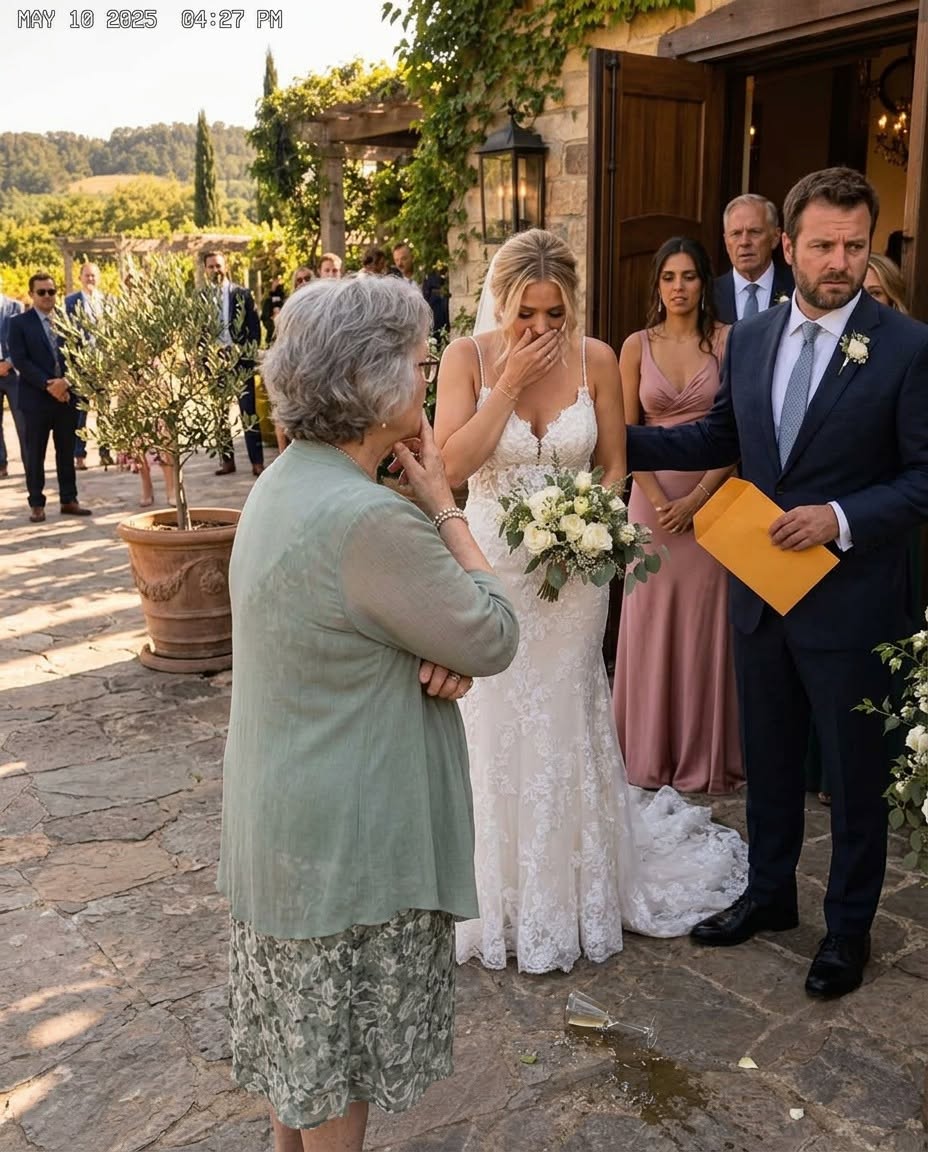
Madison reached the vineyard doors before I did and planted herself in front of them, one hand gripping the skirt of her ivory dress. “What are you doing here?” she demanded, loud enough for nearby guests to turn. “You were uninvited.” I looked at her, then at the man standing three steps behind me in a borrowed blue tie, holding a certified record inside a manila envelope. “You’re right,” I said. “I’m leaving.” Relief flickered across her face. Then I stepped aside and added, “But first, meet my guest.”
My name is Wendy Thornton, and I was sixty-seven years old when my son Ryan nearly married a woman whose first marriage had never legally ended. I had raised Ryan alone after his father died when he was fifteen, taught fifth grade for thirty-three years, and spent most of my adult life solving problems by writing things down rather than shouting about them. I had helped Ryan and Madison with a $4,000 venue deposit and co-signed the mortgage on their house, yet in the months before the wedding I was slowly erased from the family photo list, seated near kitchen doors, excluded from the bridal shower, and finally told by Madison that it would be “simpler” if I did not attend at all. Around the same time, I overheard a relative joking about Madison once marrying a man named Colton in Las Vegas. Ryan believed the marriage had been annulled or divorced because Madison had told him it had been “handled.” He had never seen the paperwork.
I checked the public records instead of arguing. A former student of mine who worked in county records helped locate the Nevada marriage license for Madison Renee Cole and Colton Andrew Briggs, filed nine years earlier. What we could not locate was more important: no divorce decree and no annulment in the counties we searched. When I finally found Colton, now running a contracting business forty-one miles away, he was as surprised as I was. He believed Madison and her mother had taken care of the legal dissolution years before; Sharon had even discouraged him from filing anything himself because she said the short marriage was not worth additional legal fees. Colton agreed to obtain a certified copy of the marriage record and come to the vineyard before any vows were exchanged. He was not interested in humiliating Madison. Neither was I. But my son was about to enter a marriage whose legal validity was compromised by an unresolved prior marriage, and that was no longer a family disagreement that could be managed with seating charts and polite smiles.
When Colton stepped forward at Cedar Hollow Vineyard and quietly said, “Hi, Madison,” the color disappeared from her face and her knees gave way. Once she recovered, Colton identified himself and showed the certified record, explaining that their marriage had never been formally dissolved. Sharon’s first response was not to ask whether the document was accurate but to accuse me of ruining the wedding, which told me more than any confession could have. Ryan arrived moments later and pieced the situation together in front of me, the envelope, and the guests who had begun gathering around. “I didn’t know,” he said, and then, more painfully, “I should have listened.” I did not stay to enjoy the aftermath. I had gone there to stop my son from making a life-altering commitment under false assumptions, not to watch a woman collapse under the consequences of hers. Colton and I left before the ceremony could begin, and within weeks the unresolved first marriage was finally addressed through the proper legal process.