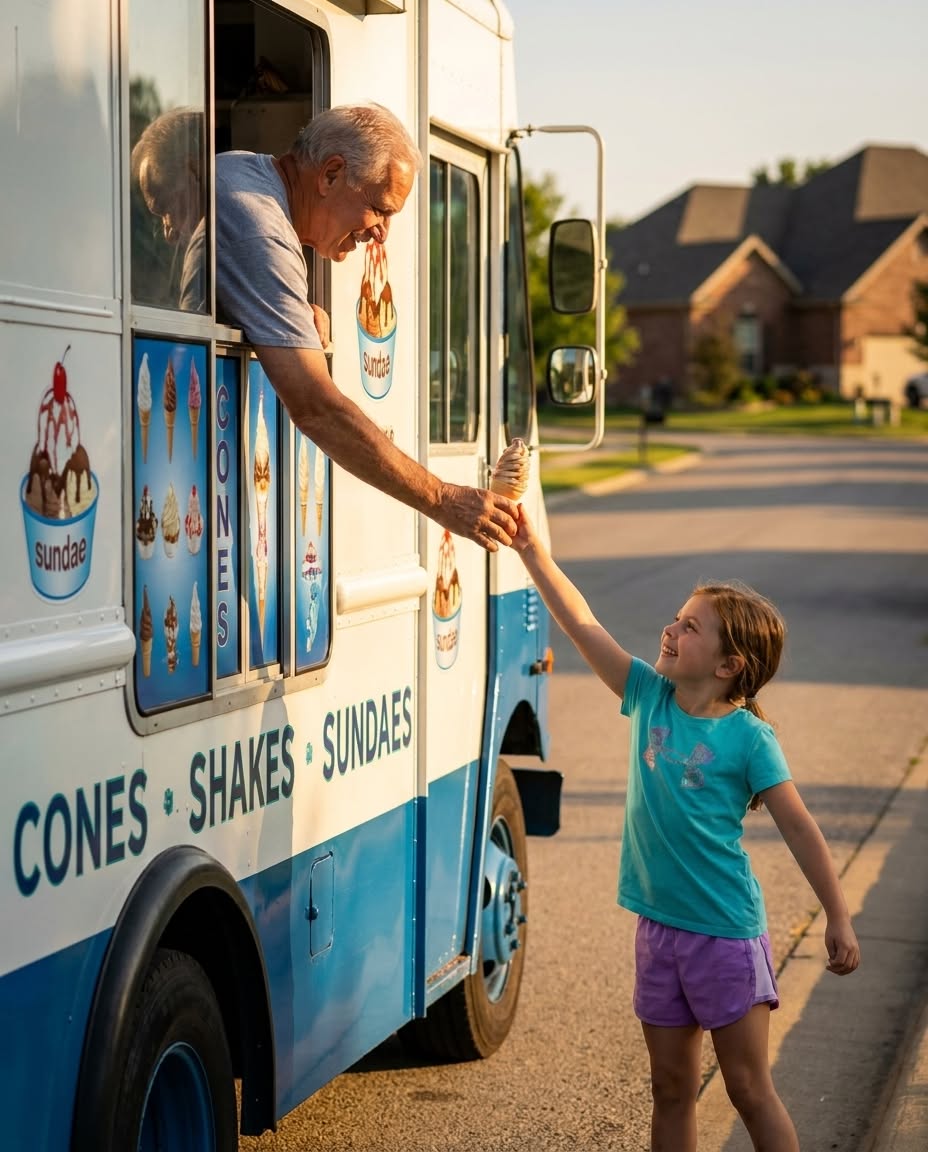
The older man behind the ice cream-truck window stared at me for several seconds before quietly saying my first name. I felt my hand tighten around my nine-year-old daughter Ellie’s shoulder because I had never met him—or at least I was certain I hadn’t. For two weeks, Ellie had been coming home with free strawberry shortcake bars from his truck, and my concern had sharpened when she told me he already knew they had once been my favorite too. Now he knew my name, the neighborhood where I had lived as a child, and details I could not remember ever telling my daughter. When I demanded an explanation, he reached below the counter and brought out an old, creased photograph. In it, an eight-year-old version of me stood smiling beside an ice cream truck, strawberry bar in hand, with a dark-haired young man resting one hand on my shoulder. I looked from the photograph to the gray-haired driver in front of me and finally understood that the stranger was not a stranger at all.
His name was Ben, and more than thirty years earlier he had been the best friend of my older brother, Adam. Adam was ten years older than me and, in the unquestioning way little sisters sometimes love their older brothers, he had been one of the centers of my childhood. He taught me to ride a bicycle, carried me home after I scraped both knees, pretended to complain when I followed him everywhere, and still defended me whenever anyone else teased me. Then, when I was nine, he died in a car accident. My mother never really recovered from the loss, my father buried himself in work, and two years later our family moved away from Brookside. We stopped telling stories about Adam because every story eventually ended in tears. Ben disappeared from my life as part of that same silence, and over time entire stretches of those summers blurred into fragments I no longer knew how to reach.
Ben turned the photograph over and showed me five faded words written in my mother’s handwriting: “Keep an eye on her.” After Adam died, my mother had asked Ben to watch for me during the summers when he drove his uncle’s ice cream route through our neighborhood. She worried constantly and believed Adam would have wanted someone familiar nearby. So whenever Ben saw me waiting on the curb, he stopped. Sometimes I had money and sometimes I didn’t, but if I asked for the strawberry shortcake bar Adam used to buy me, Ben gave it to me anyway. Decades later, after retiring from his regular career, he returned to driving an ice cream truck simply because he enjoyed it—and by pure chance my daughter began appearing at his window. Ellie had mentioned my name, Brookside, and enough small details over several conversations for Ben to wonder whether she might be connected to the little girl he remembered. That possibility sent him searching through an old box until he found the photograph my mother had entrusted to him all those years ago.
Standing beside the truck, I realized that my suspicion of Ben had been reasonable, but the truth behind his attention was nothing like the danger I had imagined. The photograph was not evidence of something threatening; it was evidence of a promise someone had quietly kept. When Ellie asked whether Uncle Adam had been nice, I discovered something more uncomfortable than anything Ben had said: my daughter barely knew who my brother was because I had repeated my parents’ response to grief. I had protected myself by turning Adam into a name rather than a person. Ben began telling her stories—the way I followed Adam everywhere, how the three of us spent summer afternoons around bicycles and basketballs, and how Adam would buy me another ice cream if I dropped mine. With each detail, memories returned in flashes. From a psychological standpoint, grief does not erase memory neatly; people often avoid reminders because those reminders carry pain, and avoidance can gradually separate us from the good memories surrounding the loss as well. I had spent years believing I was protecting myself from Adam’s death when, without realizing it, I had also been distancing myself from his life.