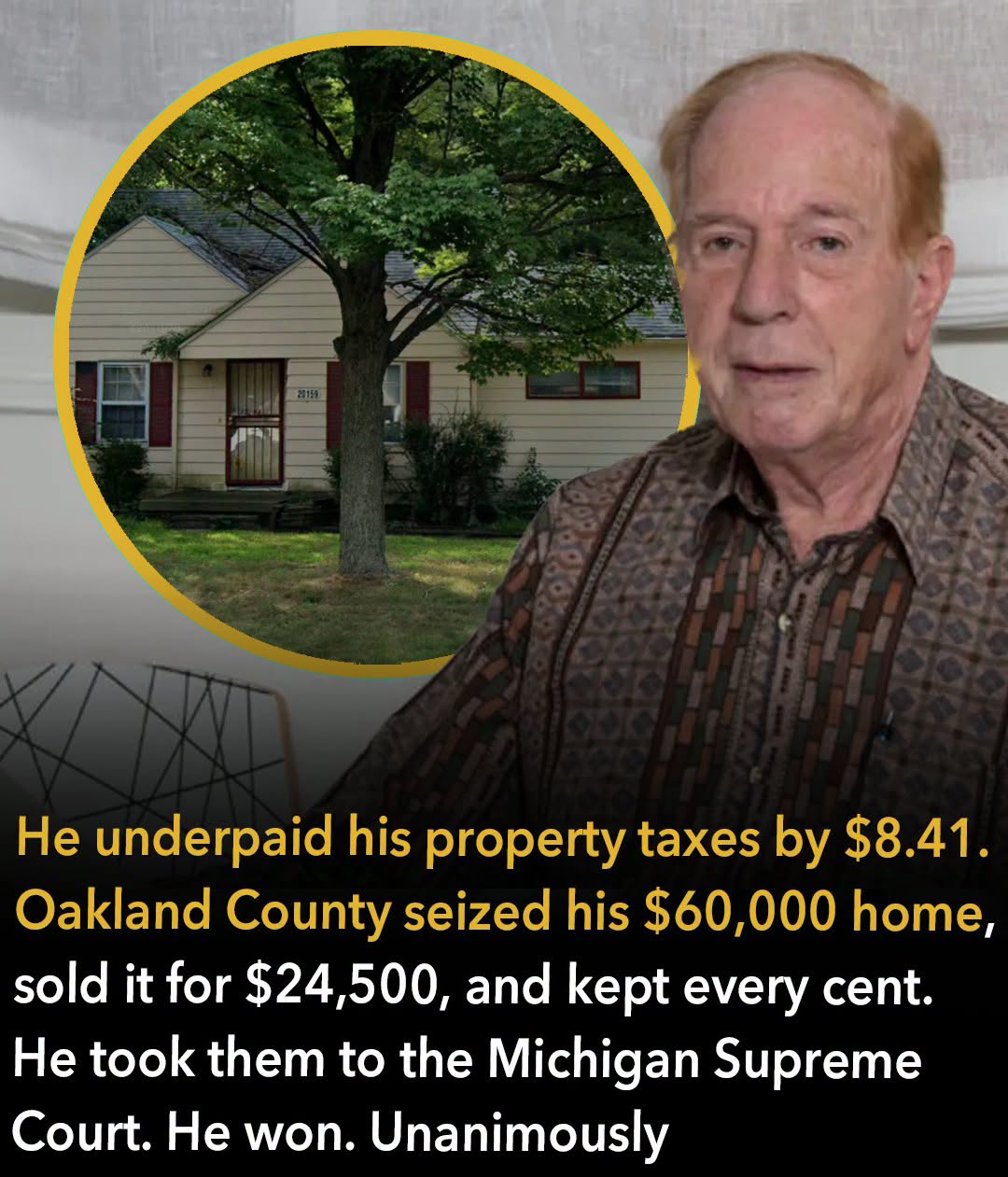
Eight dollars and forty-one cents.
It’s difficult to imagine such a small amount of money becoming the center of a legal battle involving a piece of property worth tens of thousands of dollars.
But that’s essentially what happened in Michigan in a case that eventually reached the state’s highest court.
The dispute involved Rafaeli, LLC, which purchased a rental property in Southfield, Michigan, for $60,000 in 2011.
Then came a problem with the property taxes.
According to the Michigan Supreme Court’s decision, Rafaeli underpaid its 2011 property taxes by just $8.41.
That tiny shortage would eventually have enormous consequences.
From $8.41 to $285.81
The original amount was small, but interest, penalties and fees accumulated.
By the time Oakland County foreclosed on the property, the amount owed had grown to $285.81.
The county ultimately obtained the property through Michigan’s tax-foreclosure process.
But what happened afterward became the heart of the legal dispute.
The property was sold at auction for $24,500.
That amount was dramatically larger than the tax debt.
Yet under the system being challenged at the time, the county retained the remaining proceeds instead of returning the surplus to the former property owner.
In other words, the controversy wasn’t simply about whether the government could collect unpaid taxes.
The central question became:
Could the government keep money from the sale that exceeded what it was actually owed?
The Fight Goes to Court
Rafaeli and another property owner challenged the practice.
Their case eventually reached the Michigan Supreme Court.
The property owners argued that while the government had every right to collect legitimate taxes, interest and penalties, it should not be allowed to take the additional value left over after those debts had been satisfied.
Oakland County defended its actions under Michigan’s tax foreclosure law.
The dispute raised a much larger constitutional issue involving private property rights.
And in July 2020, Michigan’s highest court issued its decision.
A Unanimous Decision ⚖️
The Michigan Supreme Court ruled unanimously in favor of the property owners on the key issue.
The court concluded that former property owners had a protected property interest in the surplus proceeds remaining after their tax debts were paid.
Keeping that surplus amounted to an unconstitutional taking without just compensation under the Michigan Constitution.
The decision did not mean that property owners could simply ignore their taxes.
Governments still have the authority to collect unpaid property taxes along with applicable penalties, interest and fees.
But the ruling drew an important line:
Collecting a debt is one thing. Keeping value beyond that debt is another.
Why the $8.41 Became So Important
The case attracted attention partly because of how extraordinary the numbers appeared.
The original shortage was only $8.41.
With additional charges, the debt grew to hundreds of dollars.
Yet the property itself was ultimately sold for tens of thousands.
That contrast transformed what might otherwise have been an obscure property-tax dispute into a significant case about government power and individual property rights.
The Michigan Supreme Court’s ruling established that the government could not simply retain surplus proceeds from such a tax foreclosure without compensating the former owner.
For Rafaeli, an $8.41 mistake had turned into years of litigation.
But the case ultimately produced a decision whose importance extended far beyond a single property in Oakland County.
Sometimes the biggest legal battles begin with surprisingly small numbers.
In this one, it began with eight dollars and forty-one cents.
And it ended with a unanimous ruling from Michigan’s highest court. ⚖️🏠
It Started With an $8.41 Property Tax Shortfall — Then the Case Reached Michigan’s Supreme Court