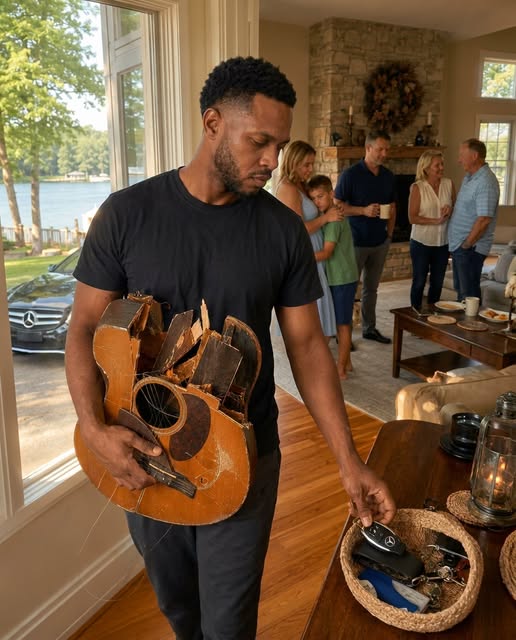
Marcus Reed was standing in his parents’ lakehouse living room with the shattered body of his 1975 Gibson Hummingbird in his hands when his nephew laughed and said the guitar must have been fake. The spruce top was split down the middle, the bridge had been torn away, and pieces of sunburst finish lay across the hardwood like broken glass. Outside, the Kentucky lake still shimmered in the Labor Day sun, but inside, the room had gone airless. Tyler, only nine, said his father Derek had told him real Gibsons were tough and that Uncle Marcus probably wasted money on cheap things. Derek turned pale, Clare rushed to protect her son, and Marcus waited for someone — anyone — to say the obvious. No one did. His father only crossed his arms and said, “It’s just a guitar. You can get another one.”
That guitar was not just furniture, decoration, or a hobby piece Marcus had brought for attention. He had saved five years to buy it, paying $8,000 from session work in Nashville, where the instrument had appeared in dozens of recording sessions and carried the sound that helped pay his bills during slow months. It was vintage, irreplaceable in the way older instruments can be, not because another acoustic could never be purchased, but because this one had its own wood, age, tone, scratches, and history. Marcus had spent years being treated as the difficult one in a family that excused Derek’s arrogance, Clare’s defensiveness, and Tyler’s lack of consequences. So when everyone told him to forgive, let it go, and remember that family mattered more than property, Marcus realized the rule only applied when he was the one absorbing the loss. By dinner, they were eating steaks under string lights as if nothing had happened.
The next morning, Marcus made a decision that changed the family forever. He took Derek’s Mercedes key from the entry table, and soon the car Derek bragged about more than most people discussed their own children was no longer sitting near the boat ramp. When Derek saw what had happened, screaming that his car was ruined, Marcus repeated the same words the family had used on him: it was just a car, and he could buy another one. The shock on their faces told him everything. Suddenly replacement cost mattered, emotional attachment mattered, debt mattered, consequences mattered. Derek threatened to call the police, but Marcus told him that any report would also include the destroyed guitar, the statements Tyler made about Derek’s comments, and the role an adult had played in a child damaging someone else’s professional property. The family that had demanded forgiveness now found itself terrified of documentation.
The legal fight that followed exposed far more than a ruined instrument and a damaged vehicle. Attorneys exchanged letters, claims, counterclaims, insurance questions, liability concerns, and settlement demands, while discovery revealed that Derek’s polished image had been built on debt: the Mercedes loan, home equity borrowing, credit cards, and personal loans hidden behind arrogance. Marcus’s attorney pushed the claim for the destroyed guitar, related damages, and the family’s attempt to dismiss his loss as meaningless. Eventually Derek dropped his lawsuit, Marcus dropped the counterclaim, and Derek agreed to repay the $8,000 in installments while he and Clare signed an affidavit acknowledging that Derek’s influence had contributed to Tyler’s actions. Tyler later sent an unscripted letter admitting he had broken the guitar because Derek said it was fake. That letter, more than any legal document, proved what Marcus had begun to understand: the child had done wrong, but the adults had built the lesson that led him there.
Marcus never got the Gibson back, and he never pretended another guitar could replace it. He bought a different instrument, wrote new music, and built a stronger career in Nashville while his family slowly faced the damage they had tried to excuse. Clare eventually admitted she had enabled Derek, Tyler began therapy and guitar lessons, and Marcus’s parents, after months of silence and regret, finally began choosing accountability over appearances. Some relationships were repaired carefully, not by pretending the past had vanished, but by admitting what had broken and why. Marcus learned that peace is not the same as victory, and consequences rarely feel as clean as people imagine. Still, standing with a new guitar in his hands, he understood something his family had refused to see that day at the lakehouse: real family does not ask the injured person to shrink their pain so everyone else can stay comfortable. Real family learns the value of what was broken — even when the lesson comes too late.