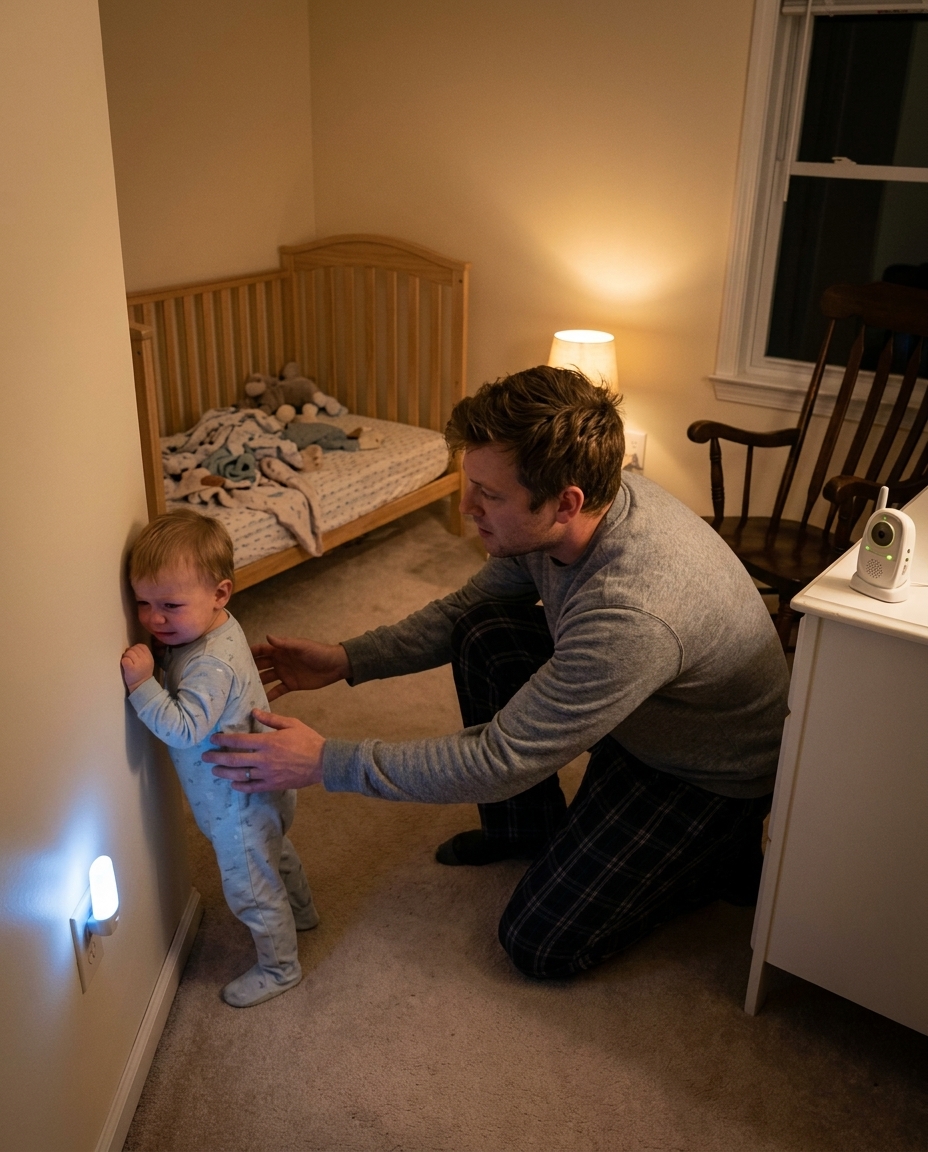
It started on a quiet Tuesday morning when Ethan was thirteen months old.
David was in the kitchen making coffee when he heard the particular silence that parents learn to distrust — the absence of the small sounds a toddler makes when he is doing something ordinary. He walked to the nursery doorway and stopped. Ethan was standing in the far corner of the room with his face pressed flat against the wall, both small fists hanging at his sides, completely still. Not crying. Not babbling. Just pressed against the wall like he was listening for something on the other side. David laughed nervously and lifted him away. Ethan did not protest. He let himself be carried to his toys and sat down and played normally for about forty minutes. Then he got up, walked back to the exact same corner, and pressed his face against the wall again. David told himself toddlers did strange things. He told himself he was overreacting. He had been raising Ethan alone since the night his wife died in the delivery room — thirteen months of solo parenthood, thirteen months of grief managed quietly so that his son would not feel it — and he knew that grief had a way of turning ordinary things into omens. He picked Ethan up again. Put him back with his toys. Watched him toddle back to the corner twenty minutes later with the focused purposefulness of someone completing a task. By nightfall it had happened eleven times. Always the same corner. Always the same spot on the wall. Always the same complete and unsettling stillness.
Over the next several days the pattern became impossible to explain away.
David moved the crib to see if it was a shadow the furniture was casting. He checked for mold. He checked for drafts. He ran his hand slowly over every inch of that section of wall looking for a crack or an insect nest or any physical explanation for why his son was drawn to this specific twelve-inch patch of painted plaster with the consistency of a religious ritual. He found nothing visible. But the wall felt different there — colder than the surrounding surface in a way that was subtle enough that he second-guessed himself every time he touched it and then confirmed again the next time. He started sleeping in Ethan’s room, pretending to answer emails while watching his son from the corner of his eye. Ethan never did it during naps. Never when David was looking directly at him. Only when he was awake and David had looked away for a moment — then he would be in the corner again, face against the wall, hands at his sides, utterly silent. Then at exactly 2:14 in the morning the baby monitor produced a sound that sent David stumbling out of bed before he was fully conscious. He ran to the nursery and stopped in the doorway. Ethan was in the corner. Face mashed against the wall. Tiny fists clenched. His whole small body was trembling so visibly that David could see it from across the dark room. David crossed the room in three steps and scooped him up and held him and said you’re safe, daddy’s here, you’re safe, over and over in the low voice he used for bad dreams. But Ethan cried harder and twisted desperately in his arms, reaching back toward the wall with both hands, trying to turn himself around, trying to get back to that corner. David held him tighter. Ethan screamed. That was the night David stopped telling himself it was a phase.
The next morning he called Dr. Mitchell.
She was a child development specialist with twenty years of experience and the particular calm of someone who had seen enough unusual behavior in children to know that most of it had an explanation and that the explanation was almost never what the parent feared. She came the following afternoon and spent an hour with Ethan — playing with him, watching him stack blocks, observing how he moved through the room, noting where his attention went and where it didn’t. Ethan laughed twice and then went suddenly quiet in the way David had come to recognize. He stood up from his toys, walked to the corner, and pressed his face against the wall. Dr. Mitchell watched without speaking. Then she walked slowly to the corner and crouched beside Ethan and placed her own hand flat against that section of wall. David watched her expression change. Not dramatically — she was a professional and professionals manage their faces — but something shifted behind her eyes that she could not entirely contain. She stood up and asked David quietly whether anyone else had had regular access to the house since his wife passed. David said no. Then he hesitated. Only babysitters, he said. But none of them lasted longer than a month. Dr. Mitchell looked back at the wall. She asked whether any of the babysitters had seemed unusual in any way. David started to say no and then stopped. There had been one. A woman named Ruth who had come highly recommended and been perfectly pleasant for three weeks and then one afternoon David had come home twenty minutes early and found her standing in the nursery with her back to the door and her hand flat against that exact section of wall, perfectly still, not doing anything David could name as wrong but wrong in a way he felt immediately and couldn’t explain. He had thanked her for her time and not called her again. He had not thought about it since. He thought about it now. Dr. Mitchell asked him which wall this was — what was on the other side of it. David frowned. Nothing, he said. This room is at the end of the house. There’s nothing beyond that wall but the exterior. Dr. Mitchell shook her head slowly. She said — David, this is a load-bearing interior wall. There is a cavity between this room and the outside. She paused. Has anyone ever opened this wall for any reason? David felt cold. No, he said. Not in the time I’ve owned the house. She asked how long he had owned it. Seven years, he said. She asked who owned it before him. He didn’t know the name immediately. He had bought it through an estate sale. The previous owner had died. He couldn’t remember the details. Dr. Mitchell looked at him steadily. Ethan chose that moment to lift one small hand and point at that cold section of wall. He had never pointed at it before. He had only ever pressed his face against it. David stared at his son’s small pointing finger. Then Ethan opened his mouth and said the three words he had never said before and has never repeated since. Mama is here.
The room went completely silent.
David could not speak. Dr. Mitchell put her hand on his arm. Ethan kept his finger pointed at the wall, his expression not frightened but certain — the absolute certainty of a child who has known something for a long time and has finally found the words for it. David called a contractor that afternoon. He told him there was a structural concern and he needed the wall opened. The contractor arrived the next morning and cut a section of drywall away from that exact spot — the spot Ethan had been pressing his face against every hour for three weeks, the spot that was colder than the surrounding wall, the spot that Ruth the babysitter had been standing with her hand against when David came home early that afternoon and felt something wrong without being able to name it. Inside the wall cavity, behind the insulation, the contractor found a small metal box approximately the size of a shoebox, sealed with tape that had dried and cracked with age. David opened it with shaking hands. Inside were photographs. Dozens of them. All of the same woman. A woman David had never seen before — young, dark-haired, in photographs that spanned what appeared to be several years, the last of which showed her looking directly at the camera with an expression that David could not stop looking at because it was not the expression of someone posing for a photograph. It was the expression of someone who did not know the photograph was being taken. There was also a folded piece of paper. A name. An address. And a date that was eleven years earlier than the date David had purchased the house. He called the police that afternoon. The investigation that followed took several months and produced findings that David has never discussed publicly and does not intend to. What he has said, to the few people he trusts enough to tell any of it to, is that the woman in the photographs had lived in that house before him and that her disappearance had never been properly explained and that after the box was found certain questions that had been closed for eleven years were reopened. He does not know what Ethan perceived in that wall. He does not know what a thirteen-month-old boy who had never met his mother could have been responding to when he pressed his face against that cold spot with the focused certainty of someone answering a call. He is not a person who believes in things he cannot explain. He is trying to remain that person. But Ruth the babysitter — the woman who had been highly recommended and perfectly pleasant and standing with her hand flat against that section of wall on the afternoon David came home early — was among the people the police spoke to during their investigation. David does not know what she told them. He knows she did not return his calls after that and that her listed phone number was disconnected within a week of the police visit. Ethan is four years old now and has not returned to that corner since the wall was opened. He does not remember any of it — or at least he does not speak of it, which David has decided to treat as the same thing because the alternative is not something he is prepared to examine. The wall has been repaired and repainted. The room is warm now — evenly, consistently warm, the cold spot completely gone. On some nights David still stands in the doorway of his son’s room and watches him sleep and thinks about a thirteen-month-old boy walking to a corner every hour with the purposefulness of someone completing a task, and he thinks about the three words, and he thinks about his wife who died the night Ethan was born and who Ethan has only ever known through photographs. He does not let himself think too long about any of it. Some explanations, he has decided, are less important than the fact that his son stopped being afraid. And his son stopped being afraid the morning the wall was opened. That is enough. That has to be enough.