My son Eli lost his front tooth two weeks before any of this happened, and the tooth fairy left him four wrinkled dollar bills and three shiny quarters that he kept in an old jelly jar on his nightstand like it was the most valuable thing he had ever owned.
Every night before bed he dumped the coins onto his blanket, counted everything carefully — four dollars and seventy-five cents, he would announce, with the satisfaction of someone who has confirmed an important fact — and then put it all back into the jar and went to sleep. My husband Ryan and I watched this ritual with the particular tenderness parents feel when their child takes something small completely seriously. The jar sat on his nightstand between his lamp and his library book, and Eli treated it the way other people treat savings accounts or family heirlooms — with a respect that was entirely disproportionate to the amount and entirely appropriate to the meaning. Last Saturday morning I took him grocery shopping, and as we were heading to the car he came running out of the house holding the jar. Just in case, he said. Just in case what, I asked. He shrugged with the philosophical calm of a six-year-old who has considered all possibilities and decided to prepare for the ones he cannot predict. You never know, he said. I laughed and buckled him into his seat. Looking back now, that was the moment the whole thing started — not in the grocery store, but in the driveway, when my son decided to bring his treasure with him because you never know. He was right about that. I was wrong to laugh.
The store was busy and we moved through the aisles the way you move through grocery stores with a six-year-old — slowly, with detours, with passionate opinions about cereal and yogurt flavors and whether the apples we were choosing were objectively the best apples or merely adequate ones.
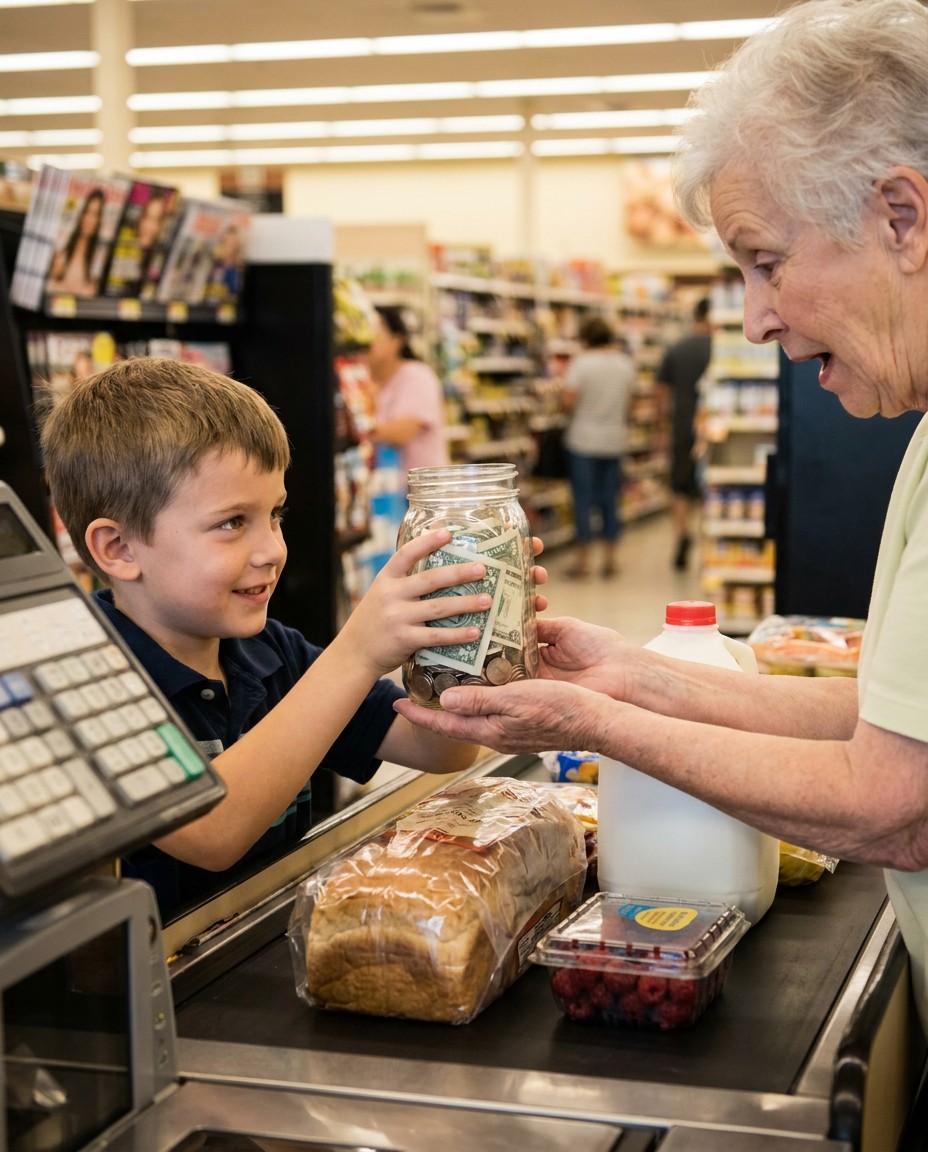
By the time we reached the checkout lanes I was ready to go home. That was when I noticed the woman standing directly in front of us in line. She was probably in her late sixties or early seventies, gray haired and thin framed, and there was nothing particularly memorable about her except for the tears she was working very hard to hide. The cashier scanned her groceries and the woman stared at the card reader with the focused expression of someone who is hoping very hard that a number somewhere will be different from what she suspects it is. The machine beeped. The cashier tried again. Another beep. The woman swallowed hard. Her card kept declining. I’m so sorry, she said quietly. I thought I had enough. The cashier gave her a sympathetic look and began setting items aside — a loaf of bread, a carton of milk, a small container of strawberries — and the woman looked at each item as it was removed with an expression I recognized as the specific devastation of someone for whom this was not simply an inconvenience. Before I could reach for my wallet, I noticed that Eli had moved. I thought at first he was just curious, moving closer to see what was happening the way children move toward anything that doesn’t make complete sense to them yet. Then I saw the jar in his hands. My stomach dropped. Eli, I said quietly. But he was already at the conveyor belt, setting the jar down with both hands, looking up at the woman with the complete and uncomplicated sincerity that children have before the world teaches them to calculate the cost of things. I have four dollars and seventy-five cents, he said carefully. Is that enough for the strawberries. The entire checkout lane went quiet in the specific way that public spaces go quiet when something happens that nobody expected and everyone recognizes as important. The cashier stopped moving. The people behind us stopped talking. The woman looked down at my son and her face crumpled and she dropped to her knees on the grocery store floor and wrapped her arms around him so tightly that my heart jumped forward in my chest. Oh, sweetheart, she said. Then she held him and cried — not the quiet crying she had been doing before, but the real kind, the kind that has been held back for too long and finally finds a way out. Thank you, she kept whispering, her voice breaking apart on the word. You don’t understand what you just did for me. You really don’t. The cashier wiped her eyes. Someone behind us sniffled. My throat tightened in the way throats tighten when you are trying to hold something together in public. Eventually the woman pulled back and looked at Eli directly. I’ll never forget this, she said. Then she stood, accepted the strawberries, and walked out of the store quickly, the way people leave when they cannot stay without falling apart completely. I watched her go. I stood there stunned while my son smiled the smile of someone who has done something entirely normal. As we walked to the parking lot I told him that was all his tooth fairy money. He shrugged. She needed it more, he said. I didn’t know what to say after that. I squeezed his shoulder and we drove home. I thought that was the end of it. I was wrong about that too.
Life returned to its normal shape — Sunday, then Monday, then Tuesday morning with coffee and cereal and the ordinary sounds of a household waking up.
Ryan had already left for work. Eli was at the kitchen table. I remembered the mail and opened the front door and froze. On our welcome mat sat a suitcase. Deep red, old leather, worn at the corners — the kind of suitcase that looked older than I was, the kind that feels like it has lived an entire life before it ever reached you. A white envelope was taped to the handle, and written across the front in shaky, uneven handwriting was a single word. Eli. My pulse quickened immediately. I stepped onto the porch. The neighborhood was completely silent — no cars, no neighbors, nothing. And then I heard it. Tick. Tick. Tick. Faint but unmistakable, coming from inside the suitcase. My stomach dropped. I spun around. Eli had followed me to the door and was standing just behind me. I held up my hand and told him sharply to stay back and go inside. His eyes went wide but he obeyed. I called Ryan and explained what I was seeing and hearing in the halting way you explain things when part of your brain is still trying to decide whether what you are experiencing is real. He told me to grab the envelope and step back and read it before calling the police. I agreed and hung up. I stood there for a moment longer, looking at the suitcase and the envelope and the shaky handwriting of someone’s name on the front. Something about that handwriting stopped me from dialing. It looked fragile and careful and deliberate — not rushed or threatening, just deeply sad in the way that very old handwriting sometimes is, as though each letter cost something to form. I stepped forward and crouched down. My hands were shaking as I tore open the envelope and unzipped the suitcase at the same time. The ticking became louder. I looked inside. And released a breath I hadn’t realized I was holding. There was no danger. Inside was an old brass clock, its hands moving steadily, its ticking filling the quiet morning air. Surrounding it, packed with the kind of care that takes time and intention, were toys and books — a stuffed bear, several small toy cars, children’s books with worn spines. Things that had been handled and loved and chosen carefully by someone who wanted them to go somewhere specific. I sat back on my heels and unfolded the letter from the envelope. Read the first line. And every drop of blood drained from my face.
Your son saved my grandson that day.
I read those words and read them again and sat down on the porch step because my legs stopped feeling reliable. The handwriting trembled across the page and the letter began — my name is Margaret. I’m the woman from the grocery store. A chill moved through me that had nothing to do with the morning air. Margaret wrote that she had not been shopping just for herself that day. She had been shopping for her grandson Leo, who was seven years old and very sick. She had been caring for Leo alone for a long time — his parents were no longer around, and he was all she had left. The day we met her in the grocery store had been one of the hardest days of her life, she wrote, because that morning her grandson had been practically on his deathbed and had asked for the one thing he wanted more than anything else in the world. Strawberries. Leo had barely been eating during his final weeks. Most foods upset his stomach. But he kept talking about strawberries, kept asking for them, and so Margaret had rushed to the store without fully checking her account balance, not knowing that several automatic medical payments had been debited the night before. When her card declined at the register it felt like her world collapsed. She knew Leo was waiting. And then my son had put his jelly jar on the conveyor belt. Margaret wrote that she drove home that day with tears running down her face. Her grandson ate some strawberries that afternoon. They made him smile. He told her they tasted exactly how he remembered them, and that made both of them happy. Then Margaret wrote the sentence that made me cover my mouth with my hand and sit on that porch step in the morning sun and cry in a way I had not cried in a very long time. Sadly, Leo passed away peacefully in his sleep later that night. I don’t think your son understands what he gave us, Margaret wrote. But because of him, my grandson got his final wish. Before he went to sleep for the last time, Leo had spent the afternoon talking about the little boy who gave away his money so that he could have his strawberries. Leo told his grandmother that he wouldn’t need his toys anymore and that the kind boy should have them. That was why the suitcase was on our porch. Inside were Leo’s favorite things — the race cars he played with, the books he loved, the teddy bear he slept beside, and the brass clock that had sat on his nightstand every night of his short life. The clock belonged to his grandfather, Margaret wrote. And then came the line I will never forget for as long as I live — I left the clock because every tick reminded me of a heartbeat. Leo’s time ran out, but kindness keeps people alive long after they’re gone. I hope Eli remembers that.
I sat on that porch step until the coffee I had been making went completely cold.
Then I stood up, went inside, helped Eli get ready for school, dropped him off, drove home, and called the number Margaret had written at the bottom of the letter. She answered on the second ring. We talked for an hour. She explained that she had gone back to the grocery store that same afternoon after telling Leo about Eli, while her neighbor watched her grandson. She had spoken to the cashier who had served her but the cashier didn’t know who we were. Another cashier overheard the conversation — a young woman named Sarah whose grandparents lived in our neighborhood and who recognized me from having seen me there before. After hearing Leo’s story, Sarah gave Margaret our address. Margaret had driven over that evening and left the suitcase on our porch. A few hours later, Leo had passed away quietly in his sleep. Before we ended the call I heard myself ask a question that surprised me as I was saying it. Would you like to meet us, I asked. There was a long pause on the other end of the line. Then her voice came back, quiet and careful. I’d love that, she said. The following weekend Eli and I met Margaret at a small park near our neighborhood. She brought photo albums full of Leo. My son brought Leo’s teddy bear. For hours she shared stories about her grandson — the funny ones and the mischievous ones and the ones that made him feel real and present in a way that photographs alone cannot quite achieve. By the end of that afternoon it felt as though we had known her far longer than a week. Over the months that followed we stayed close. When Margaret’s paperwork became overwhelming, Ryan and I helped her navigate it. When grief felt too heavy to carry alone, we visited. When she needed company, Eli was usually the first to volunteer, with the uncalculated generosity of a child who has not yet learned to ration kindness. The brass clock still sits on my son’s nightstand, between his lamp and whatever book he is reading. Every night its steady ticking fills the quiet of his room. Whenever someone asks why he keeps an old clock instead of something newer, he tells them about a boy named Leo — a boy he never met, a boy who loved strawberries, a boy whose final afternoon was made a little brighter by four dollars and seventy-five cents in a jelly jar. And every time I hear that clock ticking in the dark, I think about what my six-year-old taught me on an ordinary Saturday morning when he brought his treasure to the grocery store just in case. You never know how far a small act of kindness will travel. Sometimes it crosses a checkout lane. Sometimes it crosses a lifetime. And sometimes it comes back to your front door in a worn crimson suitcase, carrying a heartbeat that refuses to stop.