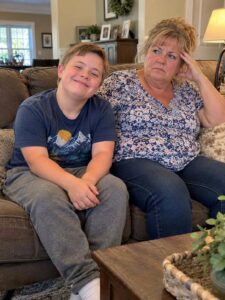
Nathan is thirty-one and has Down syndrome. He works part-time at a bakery, lives with our mom, loves superhero movies and the Cincinnati Reds, and was our dad’s closest companion for three decades. They rode the mail truck together, watched every game on the same worn couch, and shared a handshake and Sunday pancake ritual. Eleven months before the wedding,
Dad had a stroke in the backyard; Nathan found him, rode in the ambulance, kept vigil in the ICU, and held his hand until he died. At the funeral, Nathan stood by the casket and said Dad was his best friend and that he didn’t know how to be “a team” by himself. After that,
I could barely say “Dad,” and the idea of walking down an aisle alone felt unbearable. When Nathan quietly asked if he could “do Dad’s job” and walk me—explaining Dad had secretly practiced with him in the kitchen so he wouldn’t “mess it up”—he gave me the only version of the day that made sense.
My mother and Daniel agreed instantly; Patricia said nothing, only complimented my lasagna.
Her objection arrived later at that formal pot roast dinner.
Daniel’s car-ride explanation—that he was trying to avoid the war his mother always created when cornered—came with a promise:
Nathan would walk me; he just needed time to handle Patricia.
Lying awake that night, scrolling through years of photos of Dad and Nathan, I kept hearing her word ruin. By dawn,
I knew what to do. I called our photographer,
Imani, and asked her to make Nathan “the best thing in the album,” to center him in every frame he was in, and to assign a second shooter,
Marco, to photograph the guests’ faces—especially Patricia’s—while Nathan walked me. I told her I wanted the truth, whatever it looked like.
While Patricia phoned for weeks with “alternatives,” Nathan and I practiced every Sunday in Mom’s living room to Beatles processional music from my parents’ wedding. He wore Dad’s suit, tie, and too-big dress shoes stuffed with socks, walking slowly with his arm crooked just as Dad had shown him, eyes on the floor so he wouldn’t step on my dress. One Sunday he pulled out Dad’s stopped pocket watch and said Dad had planned to pause halfway down the aisle, check the time, and say something to me—a secret he’d reveal only on “the real day.
” At my bridal shower, Patricia’s cousin Aunt Ruthie quietly asked if Nathan would walk me, approved when I said yes, and then told me about Robbie, the baby brother Patricia’s parents had institutionalized in 1962 and literally cut out of family photos.
Ruthie later mailed me the saved negatives. Imani printed a black-and-white image of six-year-old Patricia holding baby Robbie, his fist curled in her hair. On the wedding day, Nathan arrived in Dad’s tailored suit, looking so much like Dad I could hardly breathe, until he told me Patricia had suggested he might embarrass me and could “change his mind.”
I told him I needed him; Mom told Daniel what Patricia had done. Daniel confronted his mother, warning that if she said one more word to Nathan, she’d watch from the parking lot. When the Beatles song began, Nathan and I walked as we’d practiced. Halfway, he stopped, took out Dad’s watch, and told the chapel that Dad had instructed him to pause and deliver a message: everything behind me was “our house,” everything ahead was “your house,” and the door to ours would never be locked. He tucked the watch into my bouquet;
I finally said “Dad” out loud and finished the walk on his arm. At the front, he placed my hand in Daniel’s and told him to take care of me. Later, he gave an unprompted toast, raising his glass “to my sister, and my new brother, and my dad, who’s watching.” Across the room, Patricia went pale, pressed a hand to her chest, then left and did not return.