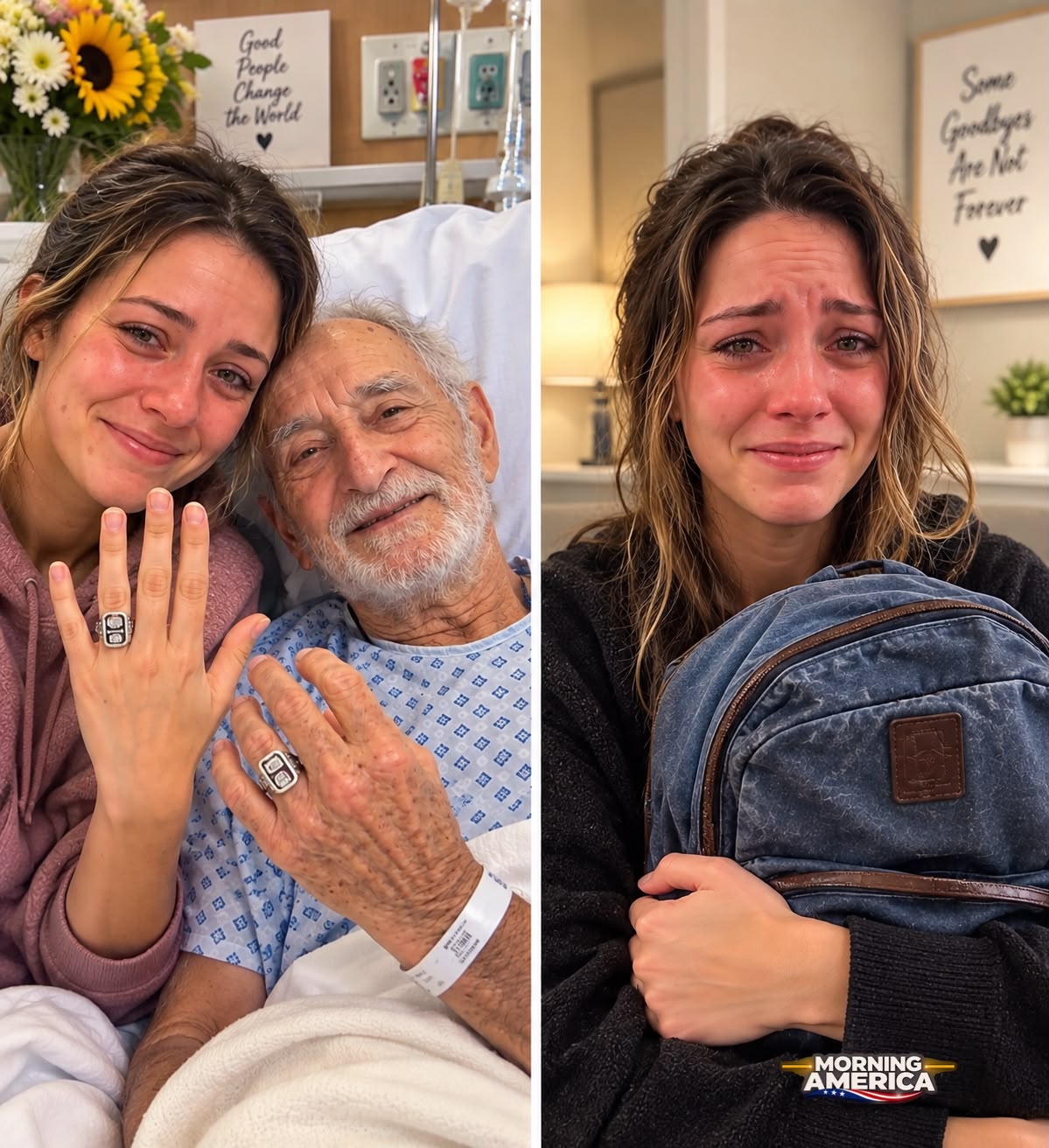
I married a dy:ing man I barely knew because I couldn’t bear the thought of him leaving this world without anyone he could call family.
For seven days, I was his wife.
Then, less than an hour after he di:ed, his attorney placed an old blue backpack in my lap.
“Daniel wanted you to have this,” Martin said. “He said you’d understand why after you opened it.”
I expected legal papers.
Money.
Maybe some secret from his past.
Instead, I found envelopes.
Dozens of them.
Each labeled with a place.
BUS STOP
GROCERY STORE
AIRPORT
LAUNDROMAT
PARK BENCH
WAITING ROOM
HOSPITAL CHAPEL
At the bottom was a worn black notebook.
I was still sitting beside Daniel’s empty hospital bed.
His peppermint tea remained untouched on the tray. The pillow still held the shape of his head.
On my finger was the ridiculous wedding ring he had given me seven days earlier—a soda-can pull tab.
It had made us laugh then.
Now I could barely look at it.
Martin had been Daniel’s lawyer and friend for nearly thirty years. Daniel had asked the hospital to call him when the end was near, which was why he arrived so quickly.
Before leaving, Martin touched the backpack.
“There are no financial surprises in there. Everything was settled before the wedding.”
Then he left me alone.
I opened BUS STOP first.
Inside was an old transit ticket.
On the back Daniel had written:
He boarded the fourth.
Next came GROCERY STORE.
A receipt for two cans of tomato soup, bread, and milk.
She accepted the soup.
AIRPORT contained an old boarding pass.
He called his daughter from Gate 14.
Then I opened the WAITING ROOM.
Inside was a visitor sticker dated nearly seven weeks earlier.
The day Daniel and I met.
On the back:
She laughed when she described her mother.
My chest tightened.
I remembered that day perfectly.
My mother had di:ed three months earlier.
I was twenty-nine, working full-time and volunteering at St. Matthew’s Medical Center because hospitals were the only places where grief felt normal.
Everyone thought I was coping well.
I went to work.
Paid bills.
Answered messages.
Helped patients.
But the truth was simpler.
I had stopped moving forward.
That afternoon, I was sitting alone in a waiting room when Daniel, three chairs away, said, “You look like someone just reminded you of somebody.”
“My mother,” I answered.
“How long?”
“Three months.”
“I’m sorry.”
Then, instead of asking how she di:ed, he asked:
“What did she sound like when she laughed?”
I stared at him.
No one had asked me that.
“She tried not to laugh,” I finally said. “She thought she was too loud.”
“What happened when she tried to stop?”
I smiled despite myself.
“She made this ridiculous little snorting sound.”
Daniel laughed.
So did I.
It was the first time since my mother’s de:ath that talking about her had made me laugh instead of cry.
“Those are the memories worth keeping,” he said.
That was Daniel.
Seventy-two years old.
Silver-haired.
Sharp-eyed.
Always carrying the same faded blue backpack.
His heart was failing, and soon after we met, he became a patient on the cardiac floor.
I started visiting him after my volunteer shifts.
He remembered everything people told him.
A receptionist’s grandson taking his driving test.
A housekeeper’s favorite song.
A nurse’s anniversary.
One afternoon I asked, “How do you remember all this?”
Daniel shrugged.
“I don’t. I just try to pay attention while people are talking.”
Five weeks after we met, his doctors told him treatment was no longer helping.
He chose comfort care.
Two days later, he asked me to marry him.
I thought he was joking.
“We’ve known each other thirty-seven days,” I said.
“I counted too.”
“You’re seventy-two.”
“I had noticed.”
“I’m twenty-nine.”
“That too.”
Then his expression changed.
“I have friends, Emma. People care about me. But I don’t have family anymore. Not in the way doctors mean when they ask who to call.”
“You won’t be alone.”
“I know.”
“Then why marriage?”
He looked at me for a long moment.
“Because once in my life, I’d like to leave somewhere belonging to someone.”
Then he added quickly, “You can say no. If you do, nothing between us changes. I will never ask again.”
That mattered.
He wasn’t asking me to rescue him.
And he wasn’t offering me anything.
Daniel already had a will. Most of his estate was going to charities and people he had known for years. Martin arranged a prenuptial agreement so there could be no confusion about money.
Daniel also formally named me as his healthcare proxy if he became unable to speak for himself.
Two days later, the hospital chaplain married us.
I wore a yellow sweater because Daniel said it made the room look “less aggressively beige.”
He wore an old gray cardigan with one missing button.
When the chaplain asked for rings, we realized neither of us had bought any.
Daniel reached for his ginger ale.
“Problem solved.”
He removed the pull tab and slipped it onto my finger.
It was enormous.
“We’ll pretend your finger is shy,” he said.
For seven days, I was Daniel Mercer’s wife.
There was nothing conventional about our marriage.
I brought him better tea.
Read to him.
Adjusted his blankets.
When he eventually became unable to communicate clearly, I followed the medical wishes he had already documented and served as his healthcare proxy.
One night, while rain tapped against the windows, I asked him if he was afraid.
“Yes,” he said.
“So am I.”
“Good.”
I frowned.
“Good?”
“It means neither of us is pretending.”
On the sixth night, he opened his eyes and whispered:
“Don’t mistake stillness for peace.”
“What does that mean?”
A faint smile touched his face.
“You’ll know.”
He di:ed the next morning while I held his hand.
And afterward, Martin gave me the backpack.
I took it home.
My mother’s favorite mug still sat beside the sink.
Four and a half months after her de:ath, I still hadn’t put it away or used it.
That night, I opened more envelopes.