What Catherine Saw
Derek opened my car door from the driver’s seat and reached across my lap like I was baggage he had decided to throw out.
“Get out, Olivia.”
The bus stop behind me was cracked concrete, rusted metal, and one leaning sign with old tape stuck to it. Across the street, a boarded-up liquor store sat behind iron bars. I did not know this part of the city. I did not know which direction led home.
“Derek, please,” I said. “What are you doing?”
He grabbed my purse. My wallet came out first. Then my debit card. Credit cards. The $32 in cash I had been saving. Then he took my phone from my jacket pocket and held it up like proof.
“You need to learn the value of money,” he said. “Figure out how to get home without mine.”
I stared at him through the blur of tears.
That morning, his “proof” had been groceries, gas, and an $80 gift for my mother, who was recovering from surgery. A blanket and a few books. Nothing reckless. Nothing selfish.
But Derek had turned it into a trial.
“Maybe when you’re ready to apologize properly,” he said, “we’ll talk.”
Then he drove away.
His taillights disappeared around the corner while I stood there with empty hands and a chest full of panic.
I sat on the bus stop bench for hours. Buses came. Buses went. Drivers looked at me through their windows. I shook my head because I had no fare, no phone, no plan, and no courage left to explain that my husband had abandoned me as punishment.
The sun slipped lower. The air turned sharp. Every sound made me flinch.
That was when I heard the tap of a cane.
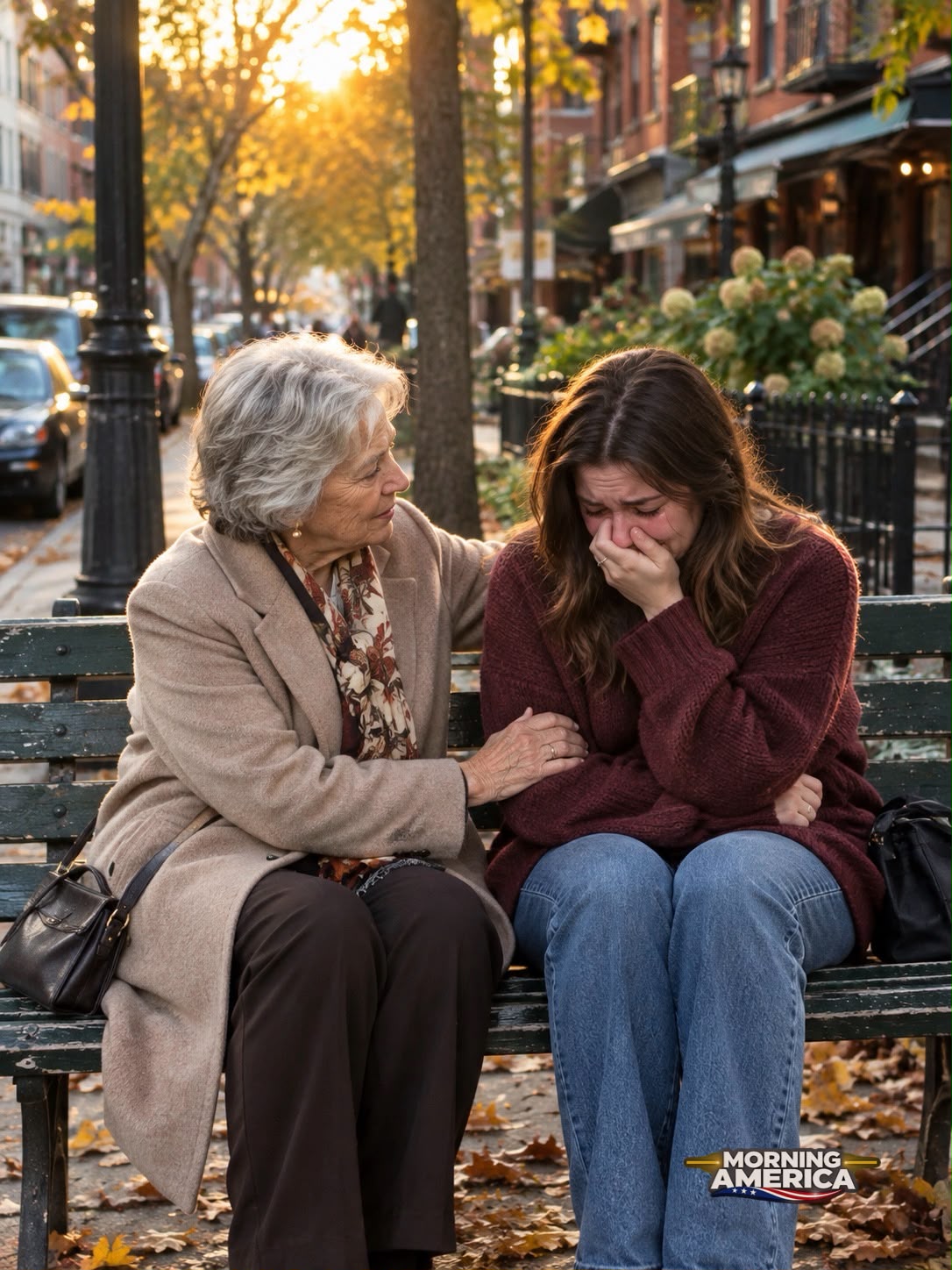
An elderly woman in dark sunglasses walked carefully toward the bench, sweeping a white cane in front of her. She sat beside me with the calm of someone who had entered a room and understood it without seeing it.
“You’ve been crying for quite some time, dear,” she said.
I wiped my cheeks quickly. “I’m okay.”
Her mouth curved slightly. “My eyes don’t work, but my ears work perfectly well.”
I broke. “My husband left me here,” I whispered. “He took my money and my phone.”
Her face changed. Not pity. Anger, controlled and elegant.
“Deliberately?”
I nodded.
So I told her everything. The credit card statement. The lectures. The way Derek controlled every dollar even though my library paycheck went
into our joint account. The friends he slowly pushed away. The apologies I gave just to keep peace in our small kitchen.
When I finished, she asked, “What will you do when you get home?”
The answer came out before I could stop it. “Apologize, I guess. Try to be better.”
Her chin lifted. “Olivia, listen carefully. Buying groceries and a gift for your sick mother is not irresponsibility. Taking your resources, isolating you, and leaving you here to teach a lesson is control.”
The word control landed harder than any insult Derek had ever thrown.
“I don’t have anywhere to go,” I said.
“Yes, you do.”
A black car turned the corner and glided to the curb, polished so clean it reflected the orange sky. A man in a gray suit stepped out and opened the rear door.
“Mrs. Wilmington,” he said.
The woman beside me stood with her cane. “My driver,” she said. “And my name is Catherine Wilmington.”
I did not react because the name meant nothing to me yet.
Then she leaned toward me and lowered her voice. “When we get into that car, pretend you’re my granddaughter.”
I blinked. “What?”
“Your husband thought he left you with no one,” she said. “He was wrong.”
Her driver cleared his throat. “Mrs. Wilmington, are you plotting something?”
Catherine smiled. “Thomas, meet Alexandra. She’ll be staying with us.”
I looked at the car. Then at the empty street where Derek had vanished. For the first time all day, my hands stopped shaking. I took Catherine’s arm.
The house she brought me to was not a house. It was white columns, iron gates, marble floors, and a staircase that curved under a chandelier. Margaret, the housekeeper, prepared a blue guest room larger than my apartment. Thomas brought soup. Catherine sat across from me like a queen who had chosen war.
Over dinner, she told me who she was. Former owner of Wilmington Industries. One of the biggest names in the state. Blind for ten years, still sharper than anyone I had ever met.
“You are not helpless,” she said. “You have been trained to feel helpless.”
I want to pause here, before the legal pad and the gala, because I think Catherine deserves a fuller explanation than the dinner table version she gave me that first night — the version I only came to understand completely over the following weeks, in the slow accumulation of small stories she told me while we sat together in her study each evening.
Catherine Wilmington had built Wilmington Industries — a manufacturing and logistics conglomerate — alongside her late husband, Edmund, across nearly four decades, though I learned, eventually, that “alongside” undersold her role considerably. She had run the company’s actual operations for most of that time while Edmund handled the public-facing relationships, a division of labor that had suited both of them until his death eighteen years earlier, when Catherine had simply continued running everything herself, without ceremony, for another decade before finally retiring.
She had lost her sight ten years ago, gradually, to a degenerative condition that had taken nearly three years to fully claim her vision. “I want you to understand something,” she told me, during one of those study conversations. “Losing my sight did not make me vulnerable, Olivia. It made me considerably more attentive to the things sighted people stop noticing — tone of voice, the specific hesitation before a lie, the particular rhythm of someone who is afraid versus someone who is simply tired. I heard you crying at that bus stop from nearly a block away, and I knew, before I’d even reached you, that whatever had happened wasn’t an accident. Accidents don’t sound like that. Cruelty has its own specific sound.”
The next morning, her lawyer arrived with a yellow legal pad. His name was Desmond Hale, a careful, precise man who had handled Catherine’s affairs for over twenty years, and who treated my situation with the same rigor he presumably applied to Wilmington Industries’ largest contracts.
“Catherine tells me your husband controls your joint finances,” Desmond said, settling into the study’s leather chair across from me. “I’d like to understand the full shape of that control before we discuss any options.”
I walked him through it — my library paycheck, deposited automatically into our joint account; Derek’s insistence, early in our marriage, that he “handle the budgeting” since he was “better with numbers”; the gradual disappearance of my own independent financial access, justified each time as practical rather than controlling.
“I’d like your authorization to review the account’s transaction history,” Desmond said. “Not to take any action yet — simply to understand the actual pattern, rather than relying on memory alone.”
I gave it. By noon, my joint accounts were being reviewed. By night, the truth started surfacing.
Derek had been withdrawing money for months. Money I earned. Money I thought we were saving. There were hotel charges, restaurant receipts, and purchases for two people on nights he told me he was working late.
I stared at the papers until the numbers blurred.
Catherine touched the edge of the folder. “Evidence has a way of helping a woman remember her own voice.”
I want to describe what those documents actually revealed, because the scope mattered considerably to everything that followed. Over the preceding eleven months, Derek had withdrawn just over $34,000 from our joint savings — money I had believed was accumulating toward a house down payment, the dream we’d discussed regularly across our four years of marriage. The withdrawals correlated, with uncomfortable precision, against a pattern of hotel charges at a boutique property across town, dinner receipts for two at restaurants I’d never visited with him, and a recurring monthly charge to a florist that, Desmond’s investigator would later confirm, corresponded to flowers delivered not to our home, but to an apartment registered under the name Brenda Castellano — Derek’s boss at the car dealership.
“He’s been having an affair with his own boss,” I said, the words feeling strange and distant in my mouth, “and funding it with money I earned.”
“It appears that way,” Desmond said carefully. “I’d recommend we move forward methodically rather than emotionally, Olivia, though I understand the difficulty of that request given what you’re looking at.”
Five days after the bus stop, Catherine told me about the gala. Children’s hospital fundraiser. Biggest social event of the season. Donors, executives, photographers, the kind of room Derek would never miss because his car dealership was a sponsor.
“And he’ll be there,” I said.
“With the woman he thought you’d never find out about,” Catherine replied.
My stomach tightened. “I can’t face him.”
“You won’t face him as the woman he abandoned,” Catherine said. “You’ll face him as the woman he underestimated.”
I want to explain what those five days actually involved, beyond the dramatic framing of preparation for a single confrontation. Desmond’s team had spent the time building a complete legal picture — documenting the financial misappropriation, preparing formal separation paperwork, and, at Catherine’s specific suggestion, contacting an attorney who specialized in cases involving coercive financial control within marriages, to ensure that whatever came next would be built on solid legal ground rather than simple emotional reaction.
“I want you to understand something important,” Catherine told me, the evening before the gala, as Margaret helped fit the emerald dress that had been altered specifically for me over the preceding days. “What we’re doing this weekend is not revenge, Olivia, though I understand it may feel satisfying in that register. What we’re actually doing is simply ensuring the truth becomes visible, in a setting where it cannot be quietly managed away the way Derek has clearly managed every other inconvenient truth across your marriage. The visibility is the point. Not cruelty for its own sake.”
Saturday night, I stepped out of Catherine’s car in an emerald dress that felt like armor. Flashbulbs popped. People whispered Catherine’s name. Thomas guided her on one side while I held the other.
Then I saw Derek near the bar. He was laughing with Brenda, his boss, a champagne glass in his hand. He looked relaxed. Happy.
Then his eyes found mine.
The glass slipped from his hand and shattered at his feet.
“Olivia?” he shouted, pushing through the crowd. “Where have you been?”
The ballroom went quiet.
Catherine stepped in front of me, her blind eyes hidden behind dark glasses, her voice cutting through the room.
“You must be the husband.”
“Catherine,” Derek said, his voice carrying the particular forced charm he deployed for anyone he wanted something from, “I had no idea you knew Olivia. This is — I’m sorry, I’m a little confused right now.”
“I imagine you are,” Catherine said. “Though I’d think the more pressing confusion should be about why your wife is standing here in an unfamiliar dress, having spent the past five days at my home, rather than wherever you assumed she’d be after abandoning her at a bus stop with no money and no phone.”
The room’s whispers had gone fully silent now, the particular silence of a crowd that has recognized it’s witnessing something it shouldn’t look away from.
“That’s — that’s not what happened,” Derek said, his eyes darting toward the gathering attention. “Olivia, can we talk privately?”
“I think Catherine’s question deserves an actual answer first,” I said, surprising myself with how steady my voice came out. “Why don’t you explain to everyone here exactly what happened, Derek? Tell them about the bus stop. Tell them about taking my wallet and my phone and driving away because I bought groceries and a gift for my mother.”
Brenda, beside him, had gone very pale. “Derek,” she said quietly, “what is she talking about?”
“Nothing,” Derek said quickly. “It’s a misunderstanding.”
“It’s thirty-four thousand dollars,” I said, my voice carrying further than I’d intended, the ballroom’s acoustics apparently designed to amplify exactly this kind of moment. “Withdrawn from our joint savings account over the past eleven months. Hotel charges. Restaurant receipts for two. Flowers delivered to an apartment registered under Brenda’s name.” I looked directly at her. “I assume you didn’t know the flowers were paid for with my library paycheck.”
Brenda’s face had gone from pale to something closer to horrified. “Derek, you told me you were divorced,” she said. “You told me the marriage ended over a year ago.”
The crowd’s murmur rose again, considerably louder this time, the specific energy of a roomful of donors and executives realizing they were watching a man’s carefully constructed life collapse in real time at his own employer’s signature charity event.
“This is not the place,” Derek said, his earlier confidence entirely gone now, replaced by something closer to panic.
“You’re right,” Catherine said calmly. “It’s not. But you chose to abandon your wife at a bus stop in a dangerous part of this city, take her phone and money specifically to leave her without recourse, and then attend tonight’s gala with the woman you’ve apparently been funding through marital theft, while telling that woman you were already divorced. I’d say the venue is the least of the problems with tonight’s timing, Mr. Castellan.”
I want to note, for clarity, that Derek’s full name was Derek Castellan — the surname shared, uncomfortably, by Brenda’s apartment paperwork, a coincidence Desmond’s investigation had flagged days earlier and that I’d been bracing myself to understand more fully, though Catherine’s pointed delivery of it in that moment made clear she’d wanted the connection to land publicly, in front of exactly the people whose opinion of Derek apparently mattered considerably to him.
“They’re cousins,” Brenda said weakly, to no one in particular. “Derek and I — his last name is just a coincidence, it’s a common—”
“I don’t think anyone here particularly cares about the coincidence of the surname,” Catherine said. “I think what they care about is that a man sponsored by this dealership left his wife stranded without resources as punishment for buying groceries, while funding an affair with marital money. I’d imagine your employer,” she said, glancing toward a cluster of dealership executives who had clearly been listening with mounting discomfort, “might find that detail relevant to whatever sponsorship decisions come next.”
I want to describe what happened in the immediate aftermath, because the public confrontation, dramatic as it was, was never actually the resolution — simply the moment the truth finally became impossible for anyone to manage quietly away.
Derek left the gala within minutes, Brenda trailing behind him in obvious distress, the dealership’s executives exchanging the particular uncomfortable glances of people calculating reputational damage in real time. I learned, weeks later, that the dealership had quietly ended its sponsorship relationship with Derek’s branch and that Brenda had been placed on administrative leave pending an internal review of the relationship’s appropriateness given her supervisory role over him.
The divorce proceedings, supported by Desmond’s thorough documentation of the financial misappropriation, moved considerably faster and more favorably than I might have managed on my own. The $34,000 was recovered in full as part of the settlement, along with additional compensation Desmond successfully argued for given the documented pattern of coercive financial control across our marriage — isolating me from independent financial access, restricting my friendships, the specific architecture of control that Catherine had named so clearly that first evening at the bus stop.
I want to describe what my life actually looks like now, eight months removed from that bus stop bench, because I think the rebuilding matters more than the dramatic gala confrontation.
I still live with Catherine, though our arrangement has evolved into something I’m not sure either of us anticipated that first night — not charity extended to a stranger, but a genuine, mutually valued companionship between two women who found each other at exactly the moment each of us needed something the other could provide. I help manage her household correspondence and reading now, paid work rather than simple gratitude, and she has, in turn, become something between a mentor and a grandmother I never had — sharp, exacting, and completely unwilling to let me shrink myself the way Derek had spent four years training me to.
I returned to my library job with a different posture entirely — no longer apologizing reflexively for ordinary purchases, no longer flinching at unexpected phone calls, no longer organizing my entire emotional state around managing someone else’s moods.
“You are not helpless,” Catherine told me, that first night, and I think about that sentence often, turning it over the way you turn over something valuable you’re still learning to fully trust you’re allowed to keep.
I was never helpless. I had simply been trained, carefully and patiently, across four years, to believe otherwise.
Catherine and I still sit together most evenings in her study, the way we did during those first difficult weeks of legal documents and mounting evidence. She asks about my day now, genuinely curious rather than gathering information for a case, and I find myself telling her things I would never have shared with Derek — small victories, minor frustrations, the ordinary texture of a life that finally, fully belongs to me.
“I heard you crying at that bus stop,” she told me recently, “and I knew immediately it wasn’t an accident. I want you to know something else, though, Olivia — I also heard, underneath the crying, someone who hadn’t fully given up. That’s why I stopped. Not pity. Recognition.”
I think about that distinction often — pity versus recognition, charity versus genuine partnership, the difference between a woman who simply rescued a stranger and a woman who recognized, in a crying figure on a broken bench, someone worth actually investing in.
Derek thought he left me with no one that evening, abandoned and powerless on a cracked concrete bench in a part of the city I didn’t recognize.
He was wrong. He had simply never bothered to notice the kind of woman who might happen to be sitting nearby, listening carefully, with ears considerably sharper than the eyes she’d lost a decade earlier.
THE END