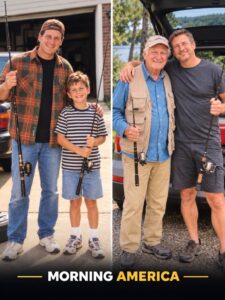
I noticed that other families had more.
I just never understood that we had less.
Dad was good at turning ordinary things into events.
On certain Saturday mornings, he would wake me before the sun came up and tell me to get dressed. By the time I stumbled into the kitchen, he had already packed sandwiches, two cans of soda, and whatever snacks had been on sale that week.
Then we’d load two old fishing rods into his station wagon and drive to Lake Merritt.
There was a marina near the entrance with rows of boats tied neatly along the docks. I loved looking at them because they seemed enormous to me back then, with shiny rails, padded seats, and motors that made our old car look tired.
We never rented one.
Instead, Dad drove farther along the lake and parked beside a narrow trail. We carried our chairs and gear through the trees until we reached a flat patch of dirt beside the water.
That became our place.
Two large sycamores leaned over the bank, giving us shade by late morning. Dad always set my chair closest to the water because I was convinced fish preferred children.
Sometimes we caught something.
Often we didn’t.
It never seemed important.
Dad taught me how to bait a hook, untangle fishing line, and sit still long enough to notice the sound of birds moving through reeds.
Mostly, though, we talked.
I told him about school, baseball, girls I liked, teachers I hated, and every strange thought an eight-year-old could produce before breakfast.
Dad listened as if none of it was silly.
Across the lake, beyond a rocky point, fishing boats often disappeared into deeper water. I used to ask why we never went out there.
Dad always gave me the same kind of answer.
“Fish out there are spoiled. They only bite expensive hooks.”
I believed him longer than I’d like to admit.
As I got older, I finally understood the real reason.
A boat cost money.
Our chairs did not.
More than thirty years passed before I thought seriously about those mornings again.
By then, I had a good job, a comfortable home, and enough money that paying for a day on a fishing charter wouldn’t affect anything important.
Dad was retired.
His hair had gone almost completely white, and the man who once carried coolers with one hand now sometimes needed both hands to get out of a low chair.
We still saw each other often.
But we hadn’t gone fishing together in years.
Then one evening, I found an advertisement for a private fishing charter on a lake about an hour from Dad’s house.
It wasn’t Lake Merritt.
This place was larger, with deeper water and professional guides who took people out before sunrise. The package included equipment, breakfast, lunch, and a full day on the water.
I booked it without looking twice at the price.
For some reason, I immediately pictured the boy I had been, standing at the marina and staring at boats Dad couldn’t afford.
It felt like I finally had a chance to give something back.
When I called Dad, I only told him to keep Saturday free.
“I’m taking you fishing.”
There was a pause before his voice softened.
“Like old times?”
“Better.”
He laughed and told me he’d find his hat.
Saturday morning, I pulled into his driveway before sunrise.
Dad came outside wearing the same faded brown fishing hat he’d owned for decades. The brim was bent, there was a small tear near the back, and I was fairly certain it had survived three presidential administrations.
I couldn’t believe he still had it.
Dad climbed into my truck and immediately started telling stories about our old fishing trips.
He reminded me about the morning I dropped an entire tackle box into the lake. Then he brought up the turtle I had once insisted was following me along the shore.
I had heard both stories dozens of times.
I laughed anyway.
About halfway through the drive, I looked over and noticed how thin Dad’s hands had become.
The skin seemed almost transparent across his knuckles.
For a moment, I wished I could slow the morning down.
I had spent years assuming there would always be another Saturday.
At seventy-two, Dad made me understand that wasn’t guaranteed.
When we pulled into the new marina, he looked through the windshield.
His expression changed slightly.
“This isn’t our lake.”
I smiled and told him that was the point.
Dad looked suspicious but followed me toward the docks.
The marina was already beginning to wake up. A few boats moved slowly across the water while men carried coolers and tackle boxes down the wooden walkways.
Our captain was standing beside a blue-and-white boat near the final dock.
He looked to be in his early sixties.