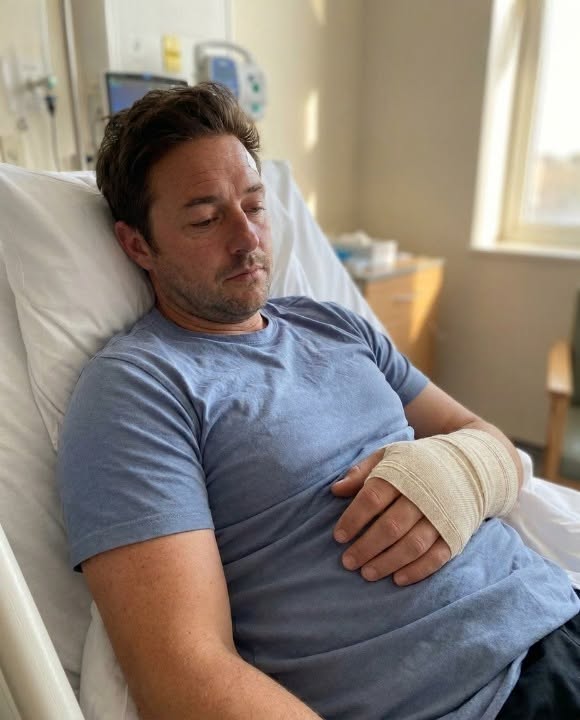
The doctor had already told me Ethan would be fine when the nurse handed me the clear plastic bag containing everything taken from his pockets after the accident. His wedding ring, wallet, cracked phone and keys slid against the plastic as I stood beneath the fluorescent hospital lights, still trying to slow my breathing after the frantic drive there. Then his wallet shifted, revealing a folded piece of paper covered in crayon. Three stick figures stood beside two tiny babies wrapped in blue blankets, and across the top someone had written, ME + DAD + THE BABIES. Underneath was a message: Maybe next time I can meet Atlas and Owen. Love, Mia. Atlas and Owen were our six-month-old twin sons. I walked straight into Ethan’s room, placed the drawing on his blanket and asked one question: “Who is Mia?” The relief disappeared from my husband’s face before he finally whispered, “She’s my daughter.”
Mia was eight years old, conceived before Ethan and I met, and he insisted he had never known she existed until her mother, Lauren, contacted him eighteen months earlier. That should have softened the revelation; instead, the timing made it worse. Ethan had learned he had a daughter while I was still enduring the last stretch of five years of IVF—years measured in injections, appointments, failed cycles and phone calls I had learned to dread—before Atlas and Owen were finally born. Through all of it, I believed Ethan and I shared everything: passwords, bank accounts, calendars, fears. Yet after returning home from the hospital, I searched our joint finances and discovered small payments scattered across those eighteen months for school supplies, shoes, dental care and a summer program. The money itself did not upset me. Ethan was supporting his child, which was exactly what a responsible father should have done. What devastated me was realizing that while I struggled to become a mother, my husband had quietly been learning how to be a father to a daughter whose name he had never once spoken to me. When he came home the next morning with a fractured wrist and concussion instructions, I asked how often he saw Mia. “Maybe twice a month,” he said. I knew immediately there was more.
I asked for Lauren’s number and met her that afternoon. She told me Ethan usually saw Mia once a week, not twice a month, and that the drawing I had found had been made only three days before his accident—on the Saturday Ethan told me he was helping a coworker move. Mia knew about Atlas and Owen, called them her brothers and believed she would eventually meet them; more painfully, she believed I already knew she existed. Lauren said Ethan repeatedly explained that he had delayed telling me because IVF had been difficult, then because I became pregnant, then because the twins arrived and I was exhausted. When I returned home, another piece fell into place. Ethan’s mother saw Mia’s drawing on our kitchen counter and reacted before she could hide it. She admitted she had known for six months and had already met Mia twice. Behind our bedroom door, Ethan finally stopped minimizing what he had done. He said he had watched me blame myself through years of infertility, then suddenly learned he had conceived a child effortlessly with another woman years earlier; he feared that meeting Mia would reopen every wound I had fought to survive. “I was trying to protect you,” he said. For the first time, I understood what bothered me most about those words: Ethan had not protected me from the truth—he had decided, without me, that I was too fragile to be trusted with it.
Three days later, I called Lauren and asked to meet Mia. The eight-year-old who arrived with a backpack and hot chocolate was not the threat my frightened mind had tried to turn her into; she was simply a child with Ethan’s cautious eyes who wanted to know whether her baby brothers were really identical and whether their father ever mixed them up. Then she pulled another drawing from her backpack. This one showed only two babies beneath the words MY BROTHERS. I realized Mia had been living inside Ethan’s deception too, believing the adults around her had already arranged a future none of us had actually discussed. I told her that she could meet Atlas and Owen someday, but I made no promise about when. Back home, Ethan looked relieved when he learned I had seen her, until I explained that meeting Mia was not forgiveness. I asked him to stay with his mother while we worked out what happened next, and I made clear that access to our twins and any future relationship between the three children would have to be handled thoughtfully rather than used as leverage to repair our marriage. We began counseling and the difficult work of rebuilding transparency around parenting, schedules and household finances, but I refused to give Ethan the immediate verdict he wanted. When he asked whether our marriage was over, I answered truthfully: “I don’t know.” For eighteen months he had controlled the truth because he feared uncertainty. Now he would have to live inside it with me.
Two weeks later, Ethan sat on our living-room rug with Owen against his chest while Atlas rolled toward a toy near my feet. He was still living with his mother, Mia had not yet met the twins, and I still did not know whether the marriage I had trusted for seven years could survive what he had hidden. At one point Ethan reached toward my hand, stopped before touching it and waited. That small hesitation mattered more to me than another apology because, finally, he was allowing me to choose what happened next instead of deciding what I could handle. Mia’s drawing remained on the coffee table between us, one corner curling upward, no longer evidence of some mysterious betrayal but proof that an innocent child had existed beyond the edges of my carefully scheduled life. IVF had taught me to survive uncertainty by organizing everything—the next injection, the next appointment, the next feeding, the exact time Ethan would arrive home. Now there was no timetable for forgiveness, no date circled for trust to return, and no guarantee that the five people unexpectedly connected by that crayon drawing would ever become the family Mia imagined. Strangely, I could breathe anyway. For the first time in eighteen months, nobody else was deciding when I was ready for the truth—or what I had to do with it.