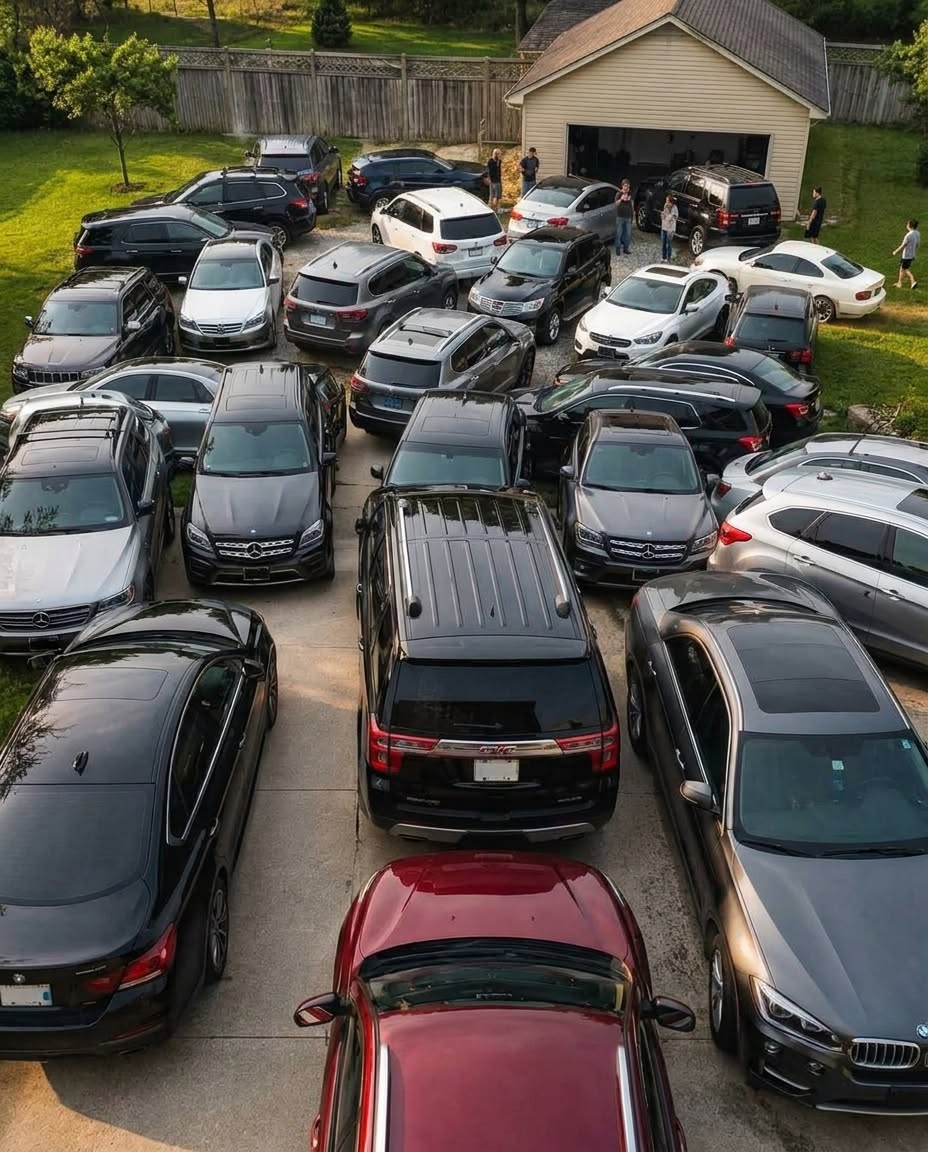
At 6:45 on a Monday morning, I stood behind my kitchen curtain and watched Linda park her enormous black SUV squarely in the middle of my driveway. She did not knock, ask permission or even glance at the PRIVATE DRIVEWAY sign she had ignored for months; she simply crossed the street in her robe and disappeared into her house. Fifteen minutes later, the low rumble of a 1967 Mustang rolled down Chestnut Street, followed by a Corvette, a Camaro, two vintage pickups and a powder-blue Cadillac long enough to resemble a small boat. One by one, I waved them into my driveway and down the private gravel lane behind my house. By eight o’clock, thirty vehicles were packed nose to tail around Linda’s SUV while their owners carried coffee, folding chairs, breakfast casseroles and pounds of bacon into my backyard. Then I heard Linda scream from the front of the house, “What the hell is this?” I stepped onto my porch with my coffee and looked at the wall of cars surrounding her vehicle. “Morning, Linda,” I said. “Some friends came for breakfast.”
My name is Carol, and Linda had been helping herself to my driveway for six months by then. After my husband Robert died suddenly from a heart attack two years earlier, I lived alone and kept my sedan in the garage, leaving most of the driveway empty. Linda apparently decided unused space was available space. At first she parked there for ten minutes while visiting someone across the street; eventually ten minutes became hours, then entire afternoons and even overnight stays. I asked politely, then firmly, and finally installed a metal PRIVATE DRIVEWAY sign. She parked directly beneath it and told me, “You barely use the thing anyway.” What Linda could not understand was why that driveway sat empty. Robert had been devoted to classic cars and belonged to the same local club for more than twenty years. Every September, our property had filled with polished Mustangs, Pontiacs and Cadillacs while Robert stood outside before sunrise directing traffic, coffee cooling on a fender as he shouted instructions nobody could hear over the engines. After his death, I sold his Pontiac and stopped hosting the gatherings because every empty space reminded me exactly where he should have been standing. Then one Thursday morning Linda’s SUV blocked my car inside the garage and I missed a specialist appointment I had waited nearly two months to attend. When I confronted her later, she shrugged. “You should’ve told me you needed the driveway this morning.” That was when six months of patience finally ran out.
That evening, I opened a drawer containing Robert’s reading glasses, an old tire-pressure gauge and the car-club directory I had not touched since his death. I called George, the club president, and asked whether everyone might like breakfast at my house again—Monday morning, seven sharp. “Bring everybody,” I told him. Linda could not have cooperated more perfectly: her own driveway was being landscaped that morning, so she parked in mine without permission at 6:45. When the thirtieth vehicle arrived, she suddenly found herself experiencing exactly what she had done to me—her own car inaccessible because somebody else had decided their convenience mattered more. Furious, she demanded that I move everyone immediately. “You barely use your car anyway,” I replied, giving her back the sentence she had used on me for months. But the real turning point came when the elderly driver of the powder-blue Cadillac climbed out. His name was Arthur, he was eighty-two, one of Robert’s oldest friends—and decades earlier his family had owned much of the land on our side of the street. More importantly, Arthur had personally explained the property boundaries to Linda when she purchased her house. “I showed you the property line myself,” he reminded her. Linda finally snapped, “I know whose driveway it is.” With those six words, she destroyed the one excuse I had occasionally allowed myself to believe: this had never been a misunderstanding.
Linda called the police anyway. When an officer arrived, I explained that the thirty vehicles belonged to invited guests on my private property and that Linda had repeatedly parked there despite verbal requests and clearly posted signage. Linda acknowledged that her SUV was on my property without permission, while Arthur could confirm that she had known the boundary since purchasing her home. The officer treated the dispute calmly, explaining that property ownership and permission—not whether I used every foot of my driveway every day—were what mattered, and he warned Linda to make other parking arrangements going forward. I had already made my point, so I asked several club members to reposition their cars and within minutes Linda could leave. But by then something more important was happening behind my house. The griddle hissed, people argued cheerfully about engines, coffee poured into paper cups and stories about Robert traveled around the yard. Diane, another longtime club member, handed me an old photograph taken in that very driveway years earlier: Robert beside his Pontiac, mouth open mid-shout, both hands raised as he directed a line of cars in the golden morning light. “We haven’t forgotten,” she told me. Looking at his face, I realized I had spent two years believing silence was the safest way to carry my grief. That morning, surrounded by thirty cars and people who still remembered my husband, I laughed so hard that George stopped cooking eggs just to tell me how much everyone had missed hearing it.
Linda never parked in my driveway again. Months later, when I hosted another breakfast—not as retaliation this time, simply because I wanted my friends back—she saw the classic cars approaching and quietly moved her SUV farther up her own driveway to give Arthur’s Cadillac more room. Arthur noticed, of course. “Progress?” he asked, raising one white eyebrow. “Don’t jinx it,” I told him. Then he looked over the cars gathering on my property and smiled. “Looks like you’re using that driveway after all.” I smiled too, although by then I understood that it had never truly been unused. For two years, that empty stretch of asphalt had been holding Robert’s absence: September mornings, engines warming in the cold, coffee forgotten on fenders and the sound of the man I loved shouting directions over the noise. I thought thirty cars would teach Linda that an empty piece of property still belonged to the person who owned it. They did. What I never expected was the lesson waiting for me: I had confused keeping part of my life empty with keeping Robert close. When those engines returned and my driveway filled with old friends, I did not feel as though I was replacing him. For the first time since losing him, I felt surrounded by everything he had left behind.