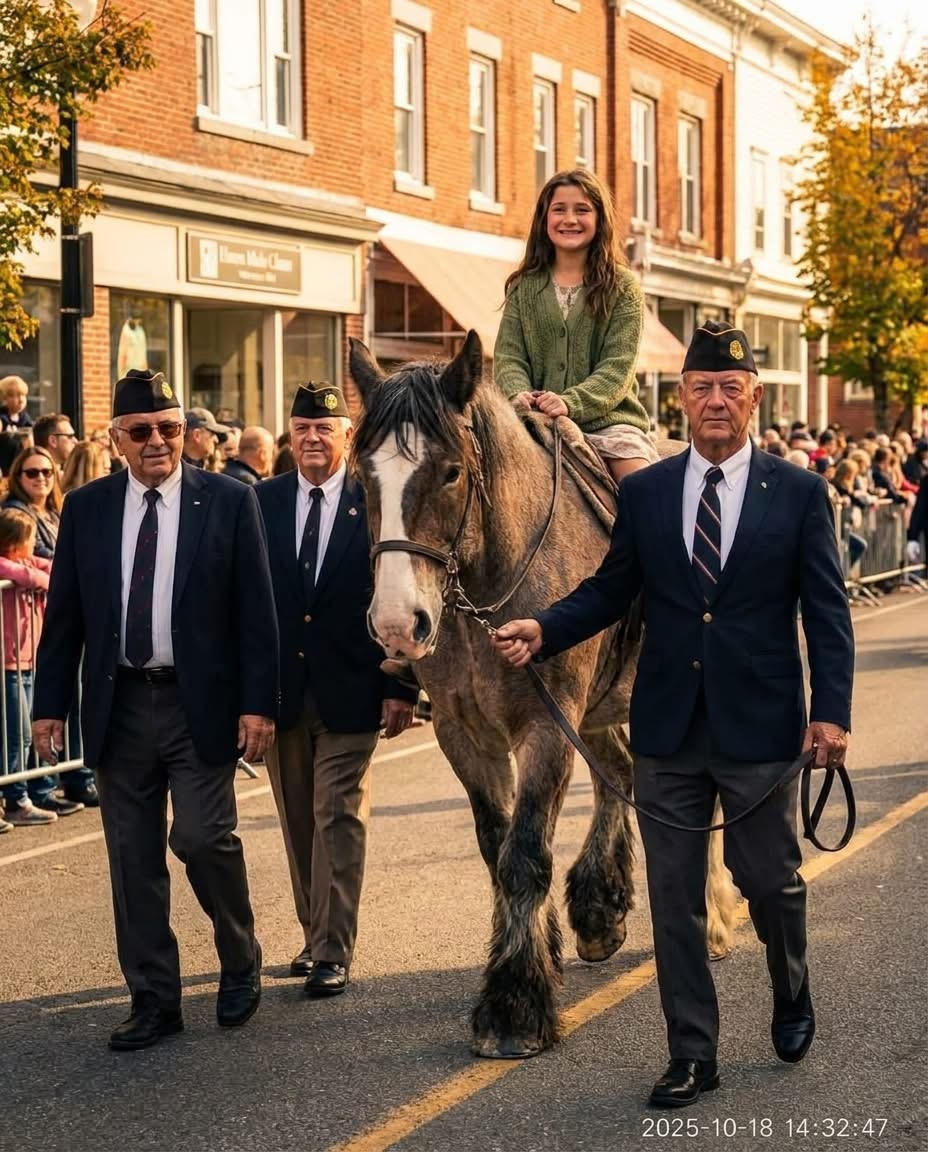
The new rules were written with both inclusion and risk management in mind. Horses would undergo veterinary examinations and temperament assessments; children would wear helmets; trained adult handlers would walk beside every animal; and participation would no longer depend on having a living father or an unblemished horse. The committee also created an advisory group that included parents, veterans, animal handlers, and child-welfare representatives. Mrs. Caldwell did something less ceremonial and more convincing: she began volunteering at Arthur’s rescue every Tuesday, cleaning stalls, filling water buckets, and learning that visible damage was not the same thing as danger. A year later, when the first official Community Heritage Ride finally arrived, Buster passed his safety check but his old injured leg was too sore to carry Emily. It broke her heart until Arthur reminded her that friendship meant refusing to ask an animal to hurt for the sake of a beautiful moment. Emily wiped her tears, took Buster’s lead rope, and walked beside him instead. When children watching from behind the barricades began joining them one by one, the procession changed again—not because of another rule, but because someone finally understood what the rules were supposed to make possible.
That evening, Emily returned to Buster’s stall and sat beside him in the straw while the old horse folded himself carefully down beside her, just as he had on the day of the rejection letter. “I didn’t ride you,” she whispered, “but I think Dad still saw.” By then, the photographs hanging inside town hall had changed too. The old images of fathers, daughters, and polished horses remained, but beside them were new ones: mothers, grandparents, foster families, veterans, children from the group home, rescue horses with scars, and Emily walking beside Buster with her head held high. Beneath the largest photograph was a small brass plaque with five words: FAMILY IS WHO SHOWS UP. That became the part of the story Arthur carried forward. Whenever a frightened child arrived at the rescue believing they were too difficult, too damaged, or too different to belong, he brought them to Buster’s stall and introduced the old one-eyed horse the same way: “He got rejected once too.” Somehow, that was usually enough.