The rejection letter shook in nine-year-old Emily’s hands as she ran into the barn and pressed herself against Buster’s stall door. The committee had written it politely, but the message was brutal: no father, no ride—and no scarred horse either. Buster, a massive retired police draft horse missing one eye and carrying an old injury down one hind leg, lowered himself painfully into the dirt beside her and wrapped his great neck around her small body. Emily had wanted to ride him in the county’s Family Heritage Ride because both of them understood what it meant to survive after getting hurt while helping someone else. Her father, a rescue worker, had died in the line of duty two years earlier. To Emily, Buster’s scars were proof of courage. To the committee, they made him “unsuitable.” From the shadows of the barn aisle, a retired combat medic named Arthur watched the girl cry into the horse’s mane, then quietly walked to his office and began making phone calls.
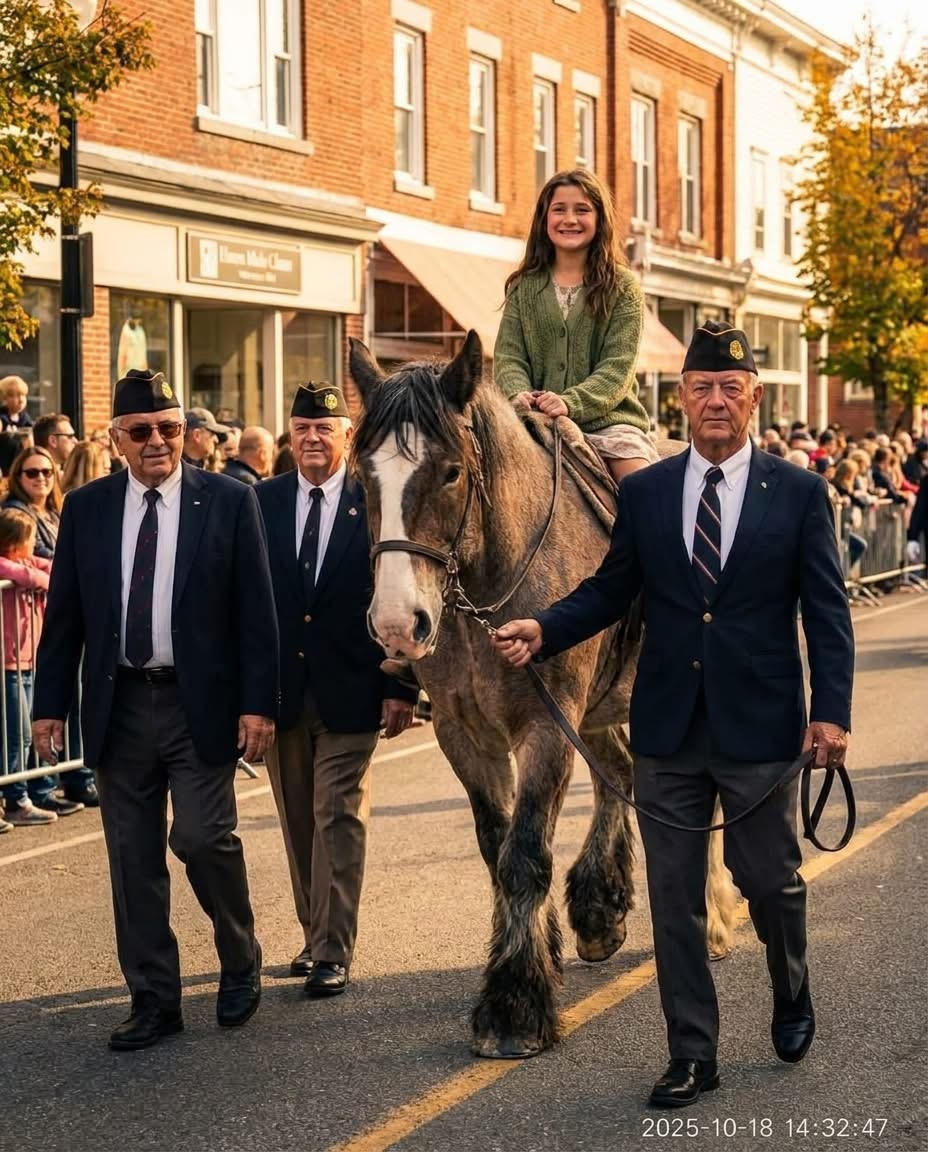
On parade morning, Emily stood behind the barricade holding her mother’s hand while polished horses and proud fathers assembled beneath the spring sunlight. Then the pavement began to tremble. Thirty veterans appeared around the corner in dark suits, some walking with visible injuries and one on a prosthetic leg, each accompanied by a rehabilitated rescue horse whose imperfections had been groomed rather than hidden. Arthur led them beside Buster. The old one-eyed horse moved down Main Street with his scar visible, his head high, looking less like an outcast than the veteran he truly was. When the group stopped in front of the stunned committee president, Arthur did not argue about regulations. “We heard there were some kids here who didn’t have fathers to ride with,” he said. “So we brought some escorts.” Emily was lifted onto Buster’s broad back, and along the line other children—kids who had lost parents, children from the local group home, children accustomed to watching other families from the sidelines—were placed on rescue horses with veterans walking beside them. The crowd’s polite applause became a roar, but the victory lasted only until the committee tried to punish the rescue for disrupting the event.
At a packed town-hall meeting two nights later, the debate finally exposed what the parade rules had really been protecting. Committee supporters argued that traditions required standards; parents and child-welfare workers answered that standards should keep children safe, not tell them their families were incomplete. Caleb Brooks, one of the veteran escorts, put the difference plainly: “Stop confusing safety with perfection.” Then Emily walked to the microphone. Her voice trembled, but she told the room that when the committee called Buster too broken to represent the town, it felt as though they were saying her father’s kind of bravery was ugly too. She did not ask anyone to hate the committee president, Evelyn Caldwell. She simply said that the rejection had made her feel as though she no longer had a family because her father had died. Then she offered the solution adults had spent days failing to find: let the ride belong to anyone who showed up for a child. Mrs. Caldwell eventually admitted that her obsession with flawless horses came from fear after her own father had been injured in a riding accident when she was young. Her apology did not erase the harm, but it opened a door. The rescue suspension was lifted, the children from the first ride were officially recognized, and the event was renamed the Community Heritage Ride.
The new rules were written with both inclusion and risk management in mind. Horses would undergo veterinary examinations and temperament assessments; children would wear helmets; trained adult handlers would walk beside every animal; and participation would no longer depend on having a living father or an unblemished horse. The committee also created an advisory group that included parents, veterans, animal handlers, and child-welfare representatives. Mrs. Caldwell did something less ceremonial and more convincing: she began volunteering at Arthur’s rescue every Tuesday, cleaning stalls, filling water buckets, and learning that visible damage was not the same thing as danger. A year later, when the first official Community Heritage Ride finally arrived, Buster passed his safety check but his old injured leg was too sore to carry Emily. It broke her heart until Arthur reminded her that friendship meant refusing to ask an animal to hurt for the sake of a beautiful moment. Emily wiped her tears, took Buster’s lead rope, and walked beside him instead. When children watching from behind the barricades began joining them one by one, the procession changed again—not because of another rule, but because someone finally understood what the rules were supposed to make possible.
That evening, Emily returned to Buster’s stall and sat beside him in the straw while the old horse folded himself carefully down beside her, just as he had on the day of the rejection letter. “I didn’t ride you,” she whispered, “but I think Dad still saw.” By then, the photographs hanging inside town hall had changed too. The old images of fathers, daughters, and polished horses remained, but beside them were new ones: mothers, grandparents, foster families, veterans, children from the group home, rescue horses with scars, and Emily walking beside Buster with her head held high. Beneath the largest photograph was a small brass plaque with five words: FAMILY IS WHO SHOWS UP. That became the part of the story Arthur carried forward. Whenever a frightened child arrived at the rescue believing they were too difficult, too damaged, or too different to belong, he brought them to Buster’s stall and introduced the old one-eyed horse the same way: “He got rejected once too.” Somehow, that was usually enough.