My son’s fiancée met the family on a Sunday at 5:30, complimented everything in the house the way nervous sweet girls do, and then walked past the mantel, saw the photograph of my late husband Raymond, and dropped her glass — not fumbled, dropped — and stood in the iced-tea puddle with both hands over her mouth and asked the question that would rewrite fifteen years of my family’s history: “Why do you have a picture of Mr. Wednesday?” She meant the man from Harmony House, the group home for foster kids on Fenton Street, who came every Wednesday for as long as anyone there could remember; who taught her to parallel park, paid for her braces, sat in the third row at an eighth-grade graduation no one else attended; who left a folder for every kid who aged out — first month’s rent, a laptop, a dentist appointment already booked — and who refused, for twenty-six years, to give the staff his name, because, as he told them, “names make it about the giver.” And my oldest son Dale, standing by the window, had to sit down — because for fifteen years, Dale had believed, argued, and finally screamed at Thanksgiving that his father was a gambler. Every Wednesday, $200 from the household account, four hours, no explanation. Dale had followed the truck once, at nineteen, to “some building on Fenton Street,” seen men shaking his father’s hand at the door, and convicted him. Raymond never once defended himself. “A man’s Wednesdays are his own, son.” He carried the verdict to his grave, four years ago, under a eulogy from Dale so polite and cold that I have watched it eat my boy from the inside ever since.
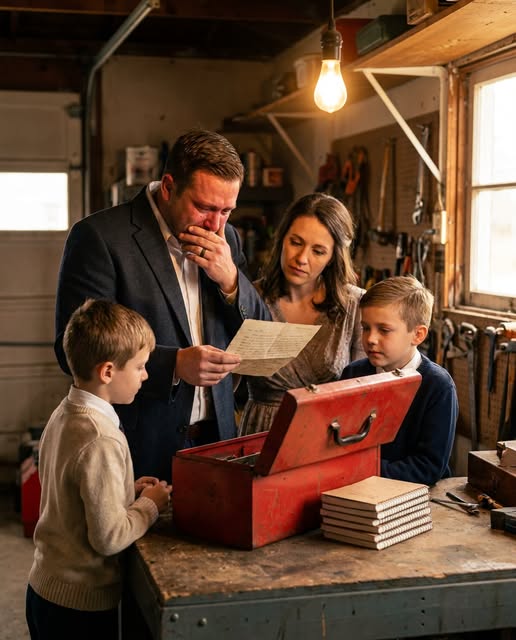
You cannot win an argument with a grave — but it turns out a grave can win one with you, if it planned ahead, and my Raymond was a planner. Olivia, once she stopped shaking, asked the question that started the second half of the evening: “Is his toolbox still in your garage? The RED one? He told us what’s in it. All of us knew. We were never allowed to forget.” The red Craftsman toolbox had sat on Raymond’s workbench, unopened, for four years — I couldn’t bear to sort it, and Dale couldn’t bear to touch it — and my whole Sunday dinner walked out to the garage in their good clothes and stood around it like a congregation. The top tray held wrenches, because my husband was incapable of a gesture without a joke. Beneath the tray: twenty-six small spiral notebooks, one per year, each Wednesday logged in his machinist’s block print — a name, a need, an amount. “Marcus — cleats + fees, $85. Tell no one, esp. Marcus.” “D’ari — bus pass + interview shirt. Practiced handshake. He’s ready.” “Livy — braces, mo. 14 of 24. Smiled with teeth today. Worth it.” Twenty-six years, over $250,000 of Wednesdays, ten thousand small entries with not one word of self-congratulation in the lot — and at the bottom of the box, beneath the notebooks, an envelope in Raymond’s hand addressed to the one reader he’d apparently always expected: “For Dale, whenever he finally opens my toolbox.”
I will not print my husband’s whole letter, because parts of it belong only to my son, but Dale read it aloud in that garage by his own choice, with his fiancée-to-be-sister-in-law crying into a dish towel and his brothers not even pretending to be composed, and I can give you the heart of it. Raymond knew. He had heard the truck behind him that night in 2009, had recognized his own son’s headlights, and had made a decision he explained to Dale in ink: “You needed me to be wrong about something, son, and I decided you could have the Wednesdays. If I told you, you’d have told your mother, and she’d have told the church, and then it becomes a story about our family being good instead of about a kid named Marcus getting cleats. The kids came first. Even before being right. ESPECIALLY before being right — being right is the cheapest thing a man can be.” And then the last paragraph, which Dale has since framed: “If you’re reading this, I’m gone, and some Wednesday kid finally talked — I always figured it’d be Livy, that girl never could keep good news to herself. So now you know, and now you have a choice, same one I had: you can feel terrible about fifteen years, which helps nobody — or you can ask yourself what a man does with the Wednesdays he’s got left. The truck keys are on the pegboard. Route’s in notebook 26. They eat dinner at 6. — Dad.” Dale stood in that garage holding the letter, forty-four years old, and asked Olivia in a wrecked voice what time it was. It was 6:40. On a Sunday. “They’ll be finishing dinner,” she said. And my son said, “Then we’ll catch dessert,” and took the truck keys off the pegboard.
The wall at Harmony House is in the hallway between the dining room and the rec room, and it is nothing official — no plaque, no donor names, because Mr. Wednesday had rules — just twenty-some years of photographs the staff quietly kept: Raymond at graduations, Raymond under the hood of a donated Honda teaching a lanky boy about alternators, Raymond in a paper birthday hat he had clearly been ambushed with, and, in the center, a child’s drawing, laminated from age, of a stick man with gray hair labeled “MR WENSDAY” holding what is either a wrench or a magic wand — the artist, now a diesel mechanic in Ohio, has since confirmed it was both. The director, a woman named Paulette who had known my husband twenty years and my name not at all, met us in that hallway, took one look at Dale’s face and then at the photo of Raymond he was holding, and said, “Oh. OH. You’re his. Honey, sit down, I’ve been saving stories for whoever you turned out to be.” What happened next took on a life none of us planned: Dale went back the following Wednesday with the truck and notebook 26, then the Wednesday after that, and by spring he had recruited his brothers into a rotation; my daughter-in-law-to-be, who aged out of that hallway herself, now runs its college-application nights; and the family attorney — because my sons inherited their father’s need to make things permanent — established the Raymond Kowalski Wednesday Fund with the life insurance Dale had never been able to bring himself to spend, endowing the aging-out folders forever: first month’s rent, a laptop, a dentist appointment already booked. The only fight was over the name. Dale wanted “Mr. Wednesday” on it; Paulette overruled him with the wall’s own logic: “Baby, he’s gone. The rule dies with him. These kids deserve to know good men have names.”
Olivia married my son in September, and at the reception, at the head table, there was one empty chair with a small red toolbox on it, wrenches in the top tray — her idea, and nobody could speak for a minute when they saw it. Dale gave the toast, and it was the second eulogy of his life, the warm one, the true one, and he ended it with the sentence I now say to anyone who will hold still: “I spent fifteen years being right about my father, and I was wrong the whole time. Check your grudges, folks. Some of them are made entirely out of the things a good man refused to say in his own defense.” My husband has been gone four years, and this past year I have learned more about him than in some decades of marriage, all of it in block print, none of it about himself. I keep notebook 14 on my nightstand — Livy’s braces year, month by month, “smiled with teeth today, worth it” — and on hard nights I read a few Wednesdays before bed. People ask me if it hurts, finding out he kept something so enormous from me, and I tell them the truth: my husband kept one secret for twenty-six years, and it was made entirely of other people’s rent, other people’s braces, other people’s graduations. A woman can live with that kind of lie. A family can be rebuilt on it. And every Wednesday at 6, somewhere on Fenton Street, it still isn’t about the giver — but the kids know his name now. It was Raymond. He smiled with teeth. It was worth it.