What the Ocean Showed Me
I had never seen the ocean before.
This sounds like the kind of thing people say for effect, but I mean it plainly: thirty-four years of life and I had never stood at the edge of the water and understood, with my body rather than my mind, what the word vast actually contains. I had seen photographs. I had watched films. None of it prepares you for the specific thing that happens when you are actually there — the way the horizon does not end, the way the sound of it is both constant and always changing, the way something in your chest responds to it before you have the language for what you’re feeling.
I had been looking forward to this for eleven months.
Martin had told me about the trip in October, standing in our kitchen after the kids were in bed, and the way he said it — I found a deal, five nights, right on the beach, the kids will love it — had produced in me the specific physical response of something long deferred becoming suddenly real. I had stood at the kitchen counter and smiled in a way that surprised me, because I had forgotten, somewhere in the accumulated weight of three children under seven and the particular exhaustion of a life that moves in a continuous present tense with very little pause, what it felt like to have something to look forward to that was genuinely mine.
Our youngest, Petra, was two and a half. Our middle, Jonah, was five. Our oldest, Maya, had just turned seven and had the specific competence of a firstborn child who has been processing adult information since she was old enough to listen. They were, all three of them, wonderful and relentless and mine in the way that children are yours — completely, without contract, without limit.
I loved them without reservation.
I was also deeply tired.
The trip was supposed to be the pause. Five nights of something different. Ocean air and the children running on sand and Martin and I, at the end of the day, sitting on a hotel balcony with something cold to drink while the kids slept, having the kind of conversation that gets crowded out by the logistics of ordinary life.
I had thought about that balcony conversation for eleven months.
In March, Martin told me his mother was coming.
Clara and I have what I would describe as a structured relationship, by which I mean: we have both, over the six years of my marriage to her son, developed an understanding of the structure, and we operate within it, and the structure mostly holds, and the cost of maintaining it is borne primarily by one of us.
Clara has opinions about my kitchen, my sauce, my ironing, my grocery choices, my parenting approach, my management of Martin’s schedule, and the general degree to which I have or have not risen to the occasion of being her son’s wife. She shares these opinions with the consistency of someone who understands that opinions, expressed regularly and with confidence, eventually shape the environment around them.
I had been shaping myself around her opinions for six years.
This is not something I am proud of, in the sense that I wish I had been different, more certain of myself earlier, less susceptible to the particular pressure of a woman who deployed love and criticism in such close proximity that they became difficult to distinguish. But it is something I understand — the specific arithmetic of keeping the peace, which is that the peace is kept by one person absorbing what another person produces, and that this can continue for a long time before the absorbing person runs out of capacity.
When Martin told me Clara was coming, I asked, as carefully as I could, whether the trip had been intended as a family trip.
“She called and said she wanted to come,” he said. “I couldn’t say no.”
I looked at my husband — a man I loved, a man who was a good father and a decent person and who had a mother he could not say no to, which was a fact of our marriage I had learned to incorporate into my understanding of the landscape the way you incorporate a hill: it’s there, you know it’s there, you plan around it.
“All right,” I said.
I went back to looking forward to the ocean.
We arrived on a Saturday.
The hotel was exactly what the photographs had promised — white and bright, with large windows and a lobby that smelled of salt air and something floral, and beyond the lobby, visible through the glass doors at the far end, the beginning of the beach.
I saw the water through those doors and felt the thing I had been waiting eleven months to feel, the chest-response to vastness, and Jonah grabbed my hand and said “MOM” in the voice he used when something exceeded his existing categories, and Maya said it looked like the pictures except bigger, and Petra looked at it with the solemn assessment of a two-year-old confronting something that required a new framework.
We checked in. We found the rooms. Martin’s mother was in the room beside ours, connected by an interior door that I noted and said nothing about.
We changed into swimsuits and went to the beach.
Clara had found the lounge chairs.
She was already reclined in one, sunglasses on, the posture of someone who has arrived at the place that was always intended for her, and she was holding a piece of paper.
“There you are,” she said, to me specifically, not to Martin, not to the children, to me.
She held out the paper.
I took it.
Your Vacation Duties was the heading.
I read it once, quickly, and the quick reading produced a kind of cognitive protest — the mind’s refusal to accept that the thing it has just read means what it appears to mean, the same protest I had experienced when Martin had said she wanted to come and I couldn’t say no, except more intense.
I read it again, more slowly.
6:30 AM: Get the children dressed. 7:00 AM: Bring coffee for Clara and Martin. 8:00 AM: Save lounge chairs for everyone. 10:00 AM: Watch the children in the water while Martin and Clara relax. 1:00 PM: Put the children down for nap. 3:00 PM: Bring afternoon snacks to the chairs. 5:00 PM: Bathe children and prepare for dinner. 7:00 PM: Manage dinner service and children’s meals. 9:00 PM: Put the children to bed so Martin can relax in peace by himself.
The blood went out of my face. I am not speaking metaphorically — I felt it go, the specific physical sensation of something draining.
“Are you serious?” I said to Clara.
She smiled.
“Sweetheart,” she said, with the particular warmth she used when she was about to say something that required warmth to land, “Martin and I work very hard. We’ve earned this vacation. You sit at home all day. You haven’t exactly earned this break.”
Jonah was building something in the sand four feet away. Petra was examining a shell with complete attention. Maya was looking at me with the expression she used when she was listening to adults and filing information.
You sit at home all day.
I am going to list, briefly and without drama, what I had done on the preceding Tuesday, which was a representative day:
I had been awake by 5:45 when Petra woke. I had managed morning routines for three children with different needs and different schedules and different tolerances for the specific difficulty of mornings. I had driven Maya to school, driven Jonah to his occupational therapy appointment — he has some sensory processing challenges, which require weekly appointments and daily strategies that I research, implement, and adjust — and driven Petra to story time at the library, which she needed for language development and social exposure and which I had found, enrolled her in, and attended every week for six months. I had managed a grocery run with Petra in the cart and Jonah navigating the sensory complexity of a busy store on a good day. I had made lunch, cleaned lunch, managed nap, managed the emotional aftermath of a child who does not want to stop napping and a child who woke early. I had picked up Maya. I had done the homework assistance and the dinner preparation and the bath time, which with three children of these ages is its own project requiring planning and patience. I had put everyone to bed by 8:30 and then sat down for the first time since 5:45, and the first thing I had done was research Jonah’s new sensory diet recommendations because his therapist had sent a document.
You haven’t exactly earned this break.
I folded the paper once, carefully.
I took it to Martin.
He read it. His expression did something complicated.
“Please don’t make a scene,” he said. “You know how she gets upset.”
I looked at my husband.
He looked at the sand.
“All right,” I said.
Then I walked back to the hotel.
The front desk receptionist was a young woman named Sofia, whose name I know because she was wearing a name badge and because I have been taught to know people’s names because people are more helpful when they understand that they are being treated as people.
“I need to ask about a few things,” I said.
Sofia looked at me with the attentiveness of someone trained to solve problems. “Of course. What can I help you with?”
I explained, quietly and specifically, what I needed.
It took eleven minutes. Sofia made several phone calls, consulted a manager named David who appeared from an office with the efficiency of someone who takes his guests’ needs seriously, and confirmed what I had asked for with the specific clarity of a hotel that wanted to retain a five-star rating.
I went back to the beach.
I sat in the lounge chair next to Petra, who had moved from the shell to a bucket of sand she was filling and dumping with the meditative repetition of a two-year-old who has found her process.
“Mama,” she said, not looking up.
“Hi, baby,” I said.
Clara and Martin were in their chairs. The afternoon was beautiful. The ocean was doing what the ocean does, which is the same thing it has always been doing, steady and indifferent and vast.
I watched my children.
I did not think about tomorrow.
Tomorrow would tell me what I needed to know.
At 6:30 the next morning, I was asleep.
At 7:15, I was still asleep.
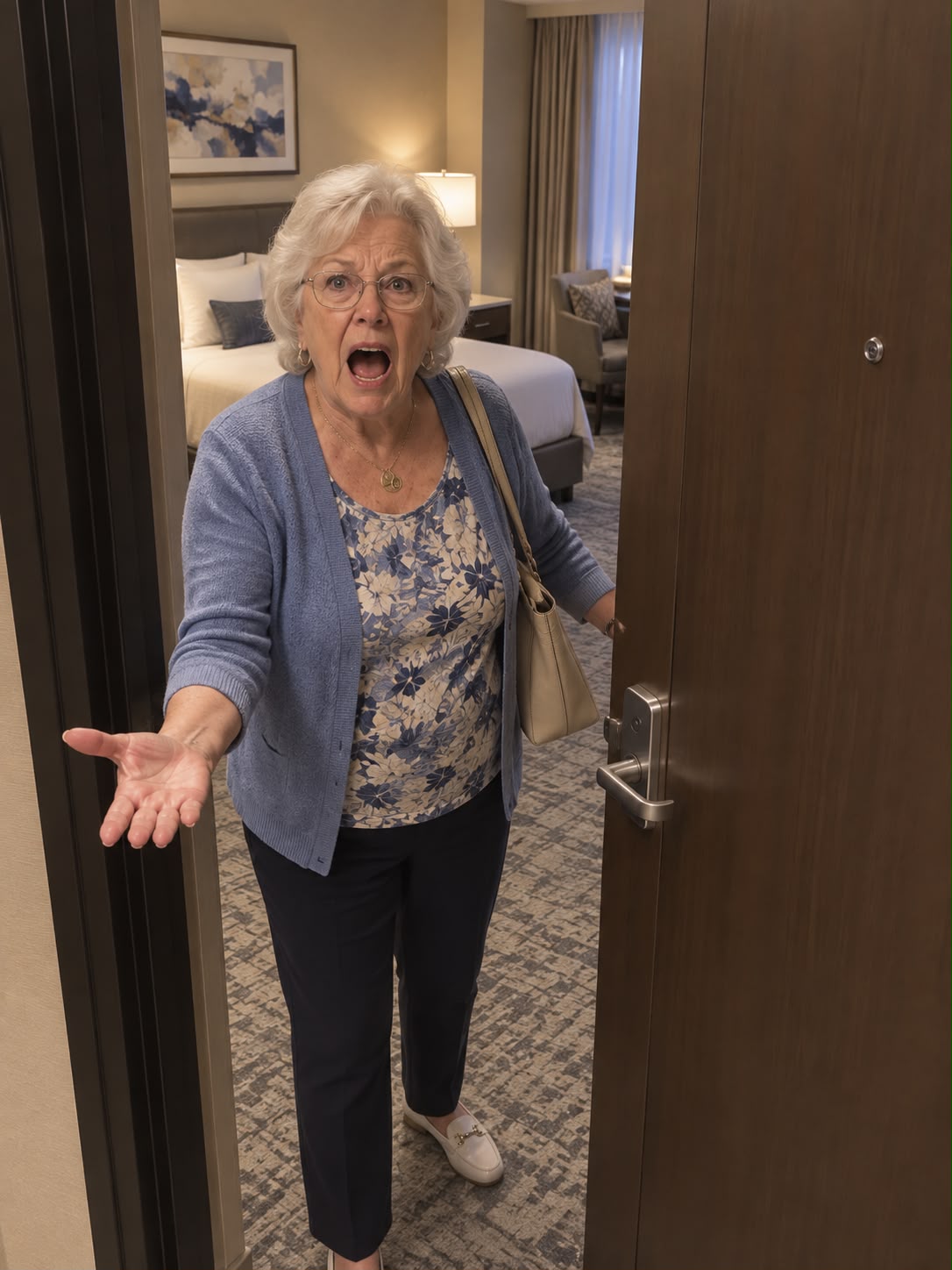
At 8:00, there was a knock on the interior door.
I let it knock.
At 8:22, my phone buzzed. Martin. I let it go to voicemail.
At 8:47, there was a louder knock, followed by Clara’s voice through the door saying my name with the specific escalation of someone who has been assuming a response was coming and is now recalibrating.
At 9:04, I heard a different knock — a knock on the corridor door, Martin’s knock.
I got up, put on the hotel robe, and opened the corridor door.
Martin was in the hallway in his swimwear with the expression of a man who has had an unusual morning.
“The room service charges,” he said. “There’s a — there’s a note from the front desk. And Mom’s chair reservation was—”
“Come in,” I said.
He came in.
I sat on the small sofa and he sat on the edge of the bed and I looked at my husband in the morning light of a hotel room in a place I had never been before and I said, in the same quiet voice I had used with Sofia at the front desk:
“I made some changes.”
I want to tell you what the changes were, because they matter and because they were, in their way, very simple.
I had asked David and Sofia to do the following:
First: separate the room charges. The reservation had been made under Martin’s name, with a single billing account. I had asked for my room — mine and the children’s room — to be separated onto a different billing account, the one connected to my personal card, which I had opened three years ago when I understood, without fully articulating the understanding, that having something separate mattered.
Second: I had asked to cancel the beach chair reservation that Clara had apparently made, in my name, for the full week, which reserved four adult chairs in a specific section. I had made a new reservation for three adult chairs, and had asked that this one be in my name only and not modifiable without my presence and identification.
Third: I had ordered room service for myself and the children for the following morning — a real breakfast, delivered at 8:30, with all the things my children liked, at a table in our room. I had noted in the order that I did not want to be disturbed before 8:15 and had asked if the hotel could hold any messages until delivery.
They had said yes, which hotels that want to retain five-star ratings say when guests make reasonable requests.
Fourth: I had spoken with the children’s activities coordinator, whose name was Reginald, about the morning program — a supervised beach activity session for children from 9 to 12 that I had seen in the welcome booklet and had not initially planned to use, because I had imagined we would all be at the beach together. I enrolled Maya and Jonah. I arranged for Petra and me to join a shorter parents-and-toddlers session at 10.
This meant that from 9 AM to noon, my children were supervised, engaged, and happy. It meant that I was with Petra. It meant that no one needed coffee delivered, chairs saved, or water-watching performed.
These were the changes.
They were not dramatic. They were not punitive. They were the actions of someone who had decided, in a hotel lobby at the edge of the ocean, that she was going to have the vacation she had been looking forward to for eleven months.
Clara came into my room at 9:11 AM.
She came through the corridor door, which Martin had not fully closed when he’d come in earlier, and she came in the way she always came into rooms that were mine — with the specific confidence of someone who understands a space as available to her rather than belonging to someone else.
“How dare you,” she said. She was not whispering.
Petra, who was eating a croissant, looked up.
“Good morning, Clara,” I said.
“The chairs. The billing. I couldn’t get information about the reservation because they said only you could authorize changes—”
“Yes,” I said. “I asked for that.”
“Do you think this is funny?” Her voice had the quality it got when she had decided that what she was experiencing was an assault on her dignity. “Do you have any idea how embarrassing it was, at the front desk, when they wouldn’t—”
“Clara.” I used her name the way Jerome had told Avery to use Scott’s name. Not to dismiss. Just to locate. “Please sit down.”
She did not sit down. But she stopped.
I looked at her steadily.
“I am on a vacation,” I said. “With my children. Martin and I have not had time away in two years, and for eleven months I have been looking forward to this trip, and yesterday afternoon you handed me a piece of paper that assigned me a schedule of tasks from 6:30 in the morning until 9 o’clock at night, and you told me I hadn’t earned a break because I sit at home all day.”
Clara opened her mouth.
“I’m going to finish,” I said.
She closed it.
“I manage three children, one of whom has needs that require weekly professional support and daily effort that I research and implement and adjust constantly. I do this every day, without breaks, without someone making me coffee, without someone saving a chair for me. I do it because I love my children and because this is my family and I choose it, every single day.” I looked at her. “Calling that sitting at home is not accurate. And writing me a duty list for my own vacation and telling me I haven’t earned rest is not something I’m going to accommodate. Not here. Not in this room. Not this week.”
Clara looked at Martin, who was sitting on the bed with the expression of a man watching something he had been avoiding for a long time arrive anyway.
“Martin,” she said. “Are you going to—”
“Let her finish, Mom,” Martin said.
We both looked at him.
He had surprised himself, I could tell. He had the expression of someone who has just heard himself say something and is deciding whether to stand behind it.
He stood behind it.
“Let her finish,” he said again.
I want to tell you that I then delivered a complete accounting of six years of accumulated grievance, but that would not be true, and the truth is more interesting.
What I said was: “The chair reservation has three seats. One for me, one for you, one for Martin. The children’s sessions run until noon. After that, we will all be at the beach together, and I would like to actually be there together — not managing logistics while everyone else rests, but there, with my family.” I paused. “If that sounds like something you can do, I’d like to try it. If it doesn’t, I understand, and the front desk can help you with arrangements.”
Clara looked at me for a long moment.
Then she looked at Petra, who had finished her croissant and was now offering Clara a piece of fruit from the room service plate with the generous earnestness of a two-year-old who has not yet learned to be complicated.
Clara took the fruit.
She sat down.
She did not apologize, which I had not expected. Clara was not a woman for whom apology came easily, and I had long since made peace with the fact that some people’s change is visible in their behavior rather than their language.
But she took the fruit. She sat down. And she said, to Petra, “Thank you, sweetheart,” in the voice she used only with the children, which was her best voice.
Martin and I had the balcony conversation.
Not the last night — the second night, after the children were asleep, which they managed on their own schedule after a day that had exhausted them in the particular satisfying way of children who have played hard in fresh air.
We sat on the balcony with something cold to drink and the ocean doing its constant, patient work in the dark below us.
“I should have told her no,” Martin said.
“Yes,” I said.
“And the list—” He stopped. “I should have said something about the list.”
“Yes,” I said.
“I keep choosing the easier thing,” he said. “Which is not—” He looked at the water. “It’s not actually easier. I just feel like it is in the moment.”
“I know,” I said.
“That’s not fair to you.”
“No,” I said. “It isn’t.”
He was quiet.
“What changed?” he said. “Yesterday. Why—”
“The ocean,” I said.
He looked at me.
“I’ve never seen it before,” I said. “I’ve been looking forward to seeing it for eleven months. And I was standing there looking at it for the first time, and she handed me a piece of paper with a duty schedule, and something in me just—” I looked at the water. “I thought: not this. Not here. Not the ocean.”
Martin reached over and took my hand.
“I’m sorry,” he said.
“I know,” I said.
We sat there for a while.
The ocean was vast and constant and entirely indifferent to our conversation, which was exactly what I needed it to be.
The rest of the week was not perfect. I want to be accurate about that.
Clara did not transform. She had her moments — a comment about the way I applied sunscreen to Jonah, a raised eyebrow at dinner when I let Petra eat the dessert first because it was vacation and I had decided to. The architecture of her personality did not reconstruct itself in five days.
But she did not hand me another piece of paper.
She sat in the third chair and watched the children in the water and, on Wednesday afternoon, she took Petra’s hand and walked with her along the tideline while the sand washed over their feet, and Petra laughed the laugh she only laughed when something surprised her with joy, and Clara looked — for a few minutes, in the late afternoon light on a beach she had invited herself to — like someone who had gotten something she hadn’t known she needed.
We have had, since then, a different kind of structured relationship.
The structure has different terms now. Not written — not a piece of paper, nothing formal. Just the thing that changed when I said, in a hotel room in the morning light: this is not something I’m going to accommodate.
Some things, said once, do not need to be said again.
They just need to be meant.
And I meant it.
And the ocean, which I had never seen before and which I have thought about almost every day since, was exactly as vast as I had needed it to be, and I stood at the edge of it with my children on the fourth morning of that trip, Petra on my hip and Jonah beside me and Maya three steps ahead because she was always three steps ahead, and I felt the thing I had been waiting for:
The specific peace of being, fully, somewhere.
Present. Not managing. Not accommodating.
Just there, at the edge of something enormous, with my family, in the sun.
It was enough.
It was, actually, everything.
THE END