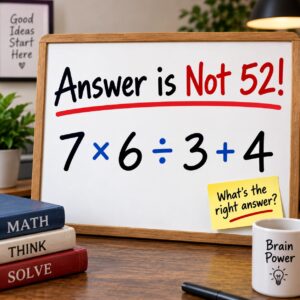
Let’s break down the equation step by step using standard order of operations.
In mathematics, we use the PEMDAS or BODMAS rule to solve expressions.
This rule stands for Parentheses/Brackets, Exponents/Orders,
Multiplication and Division, Addition and Subtraction.
According to this rule, multiplication and division have equal priority.
When both appear, you simply solve them from left to right.
Addition and subtraction come after, and are also solved from left to right.
Now, let’s look at our equation: 7 × 6 ÷ 3 + 4.
First, we handle the multiplication and division starting from the left.
The first operation on the left is 7 × 6.
7 multiplied by 6 equals 42.
Now our equation simplifies to: 42 ÷ 3 + 4.
Next, we handle the remaining division step.
We divide 42 by 3, which equals 14.
Now the equation becomes even simpler: 14 + 4.
Finally, we perform the addition.
14 plus 4 equals 18.
So, the mathematically correct answer to the equation is 18.