I was fifteen years old when I found a little girl crying beside a flooded creek in the middle of a freezing Oregon storm.
She was six.
Her shoes were pink.
Her hands were blue from the cold.
And the first thing she whispered when she saw me was:
“Please don’t let them take me again.”
My name is Mason Reed.
At that point in my life, nobody was looking for me.
Not really.
My mother had died the year before after spending most of my childhood losing battles with addiction. After that, I entered foster care.
The first placement lasted three months.
The second lasted six weeks.
The third belonged to a man named Earl Watkins.
Earl smiled whenever social workers visited.
He kept fresh cookies on the counter and family photographs on the wall.
But after the county car disappeared down the driveway, he became someone else.
So I ran.
For seven months, I lived in the Cascade foothills outside a logging town called Pine Crossing.
I slept beneath a shelter made from cedar limbs and blue plastic tarps.
I stole crackers from gas stations when I was desperate.
I drank creek water through an old camping filter I found in a dumpster.
Most important, I learned one rule:
Stay invisible.
Invisible kids don’t get sent back.
That October night, rain hammered the forest so hard it sounded like gravel hitting metal.
I was curled inside my shelter when I heard crying.
At first I thought it was an injured animal.
Then I heard a child say:
“Daddy.”
Every survival instinct told me to stay where I was.
Instead, I stepped into the storm.
I followed the sound nearly half a mile.
Lightning flashed over the trees.
That was when I saw her.
A little blonde girl huddled beneath a huge cedar, soaked through, her knees pulled against her chest.
“Hey,” I said softly.
She screamed and tried to crawl backward.
I immediately raised both hands.
“I’m not going to hurt you.”
“Don’t take me back.”
“I won’t.”
“My name’s Mason. What’s yours?”
She hesitated.
“Ellie.”
I took off my hoodie.
It was the driest thing I owned.
I wrapped it around her.
“What happened?”
Her teeth were chattering so hard I could barely understand her.
“Men took me.”
My stomach tightened.
“What men?”
“They put me in a van.”
She started crying again.
“The van got stuck. They were yelling. I opened the door and ran.”
“Where’s your family?”
“My daddy was at the picnic.”
Then I noticed the tiny black leather vest under my hoodie.
There was a patch on the back.
A silver mountain.
A black motorcycle wheel.
And the words:
BLACK RIDGE RIDERS.
I knew that name.
Everybody in Pine Crossing did.
The Black Ridge Riders were a motorcycle club with a clubhouse outside town.
They organized toy drives every Christmas.
They paid funeral costs for veterans.
They also had a reputation that made people lower their voices when talking about them.
Their president was Cole Mercer.
Big man.
Gray beard.
Supposedly scared of nothing.
And his daughter had disappeared that afternoon from a charity barbecue.
I had heard sirens earlier.
Had even seen search helicopters before the storm grounded them.
I stared at Ellie.
“You’re Cole Mercer’s daughter?”
She nodded.
Fear hit me from both directions.
If the police found a homeless runaway hiding with a missing six-year-old, what would they think?
If the bikers found me first, would they believe my story?
Then a flashlight beam appeared through the trees.
Voices followed.
“Ellie!”
But the voice didn’t sound worried.
It sounded angry.
Ellie grabbed my arm.
“That’s them.”
I picked her up.
And ran.
I knew those woods better than anyone searching them.
I knew where the ground turned to swamp.
Where old logging trails disappeared.
Where fallen trees created tunnels beneath their roots.
For nearly an hour, we hid and moved.
Three men searched behind us.
Sometimes their lights passed so close I could see rain shining on their jackets.
Ellie stopped talking.
That worried me.
“You awake?”
“Yes.”
“You have to stay awake.”
“I’m cold.”
“I know.”
I carried her toward an abandoned forestry dispatch station I had explored weeks earlier.
There was an emergency phone inside.
Old yellow receiver.
Hardwired line.
I prayed it still worked.
We reached the building after midnight.
The roof leaked.
Half the windows were broken.
But it blocked the wind.
I lifted the receiver.
Dial tone.
I nearly cried.
Then I dialed 911.
Nothing.
The storm had knocked out the main line.
I slammed the phone down.
Ellie reached inside her little vest.
“My daddy gave me this.”
She held out a metal tag on a chain.
A phone number was engraved on the back.
Under it:
IF FOUND — CALL BLACK RIDGE.
I stared at the number.
Calling the police scared me.
Calling a biker clubhouse scared me more.
But Ellie’s lips were turning pale.
So I dialed.
A deep voice answered.
“Yeah?”
“I have Ellie Mercer.”
Silence.
Then:
“Who is this?”
“My name is Mason.”
“Where is she?”
“I found her in the woods. The men who took her are following us.”
The voice changed completely.
“Where are you?”
“Old forestry station near Black Creek Road.”
“Listen carefully, kid. Lock the door. Stay with her.”
“How long?”
“Not long.”
The line went dead.
I looked at Ellie.
“Your dad knows.”
She smiled for the first time.
Then the window beside me shattered.
Glass sprayed across the wooden floor.
A flashlight blasted through the opening.
“Well, look what we found.”
Three men stood outside.
Ellie screamed.
The front door shook under a heavy kick.
I grabbed an old fireplace poker from the wall and stepped in front of her.
I was fifteen.
Hungry.
Exhausted.
Barely 130 pounds.
The man outside laughed.
“Move away from the girl, kid.”
The door cracked.
Another kick.
A hinge tore loose.
Then something strange happened.
The floor began vibrating.
At first I thought it was thunder.
The men outside stopped.
The vibration became a rumble.
Then a roar.
Not from the sky.
From the road.
I looked through the broken window.
Headlights filled the forest.
Dozens.
Then hundreds.
Motorcycles poured through the rain, their lights stretching down the mountain road farther than I could see.
The three kidnappers went completely still.
And the man standing nearest the door whispered the only words I had ever heard from an adult that sounded more frightened than I felt:
“Oh God… her father found us.”
The motorcycles kept coming.
The roar rolled through the trees until the old dispatch station seemed to shake on its foundation.
The three men outside forgot about me.
Forgot about Ellie.
They looked toward the road.
One tried running into the forest.
He didn’t get far.
Not because bikers attacked him.
Because county deputies were arriving from the opposite direction.
Red and blue lights flashed through the trees.
That surprised me.
Later I learned Cole Mercer had called the sheriff the moment his club received my phone call.
He wanted his daughter back.
But he wanted witnesses too.
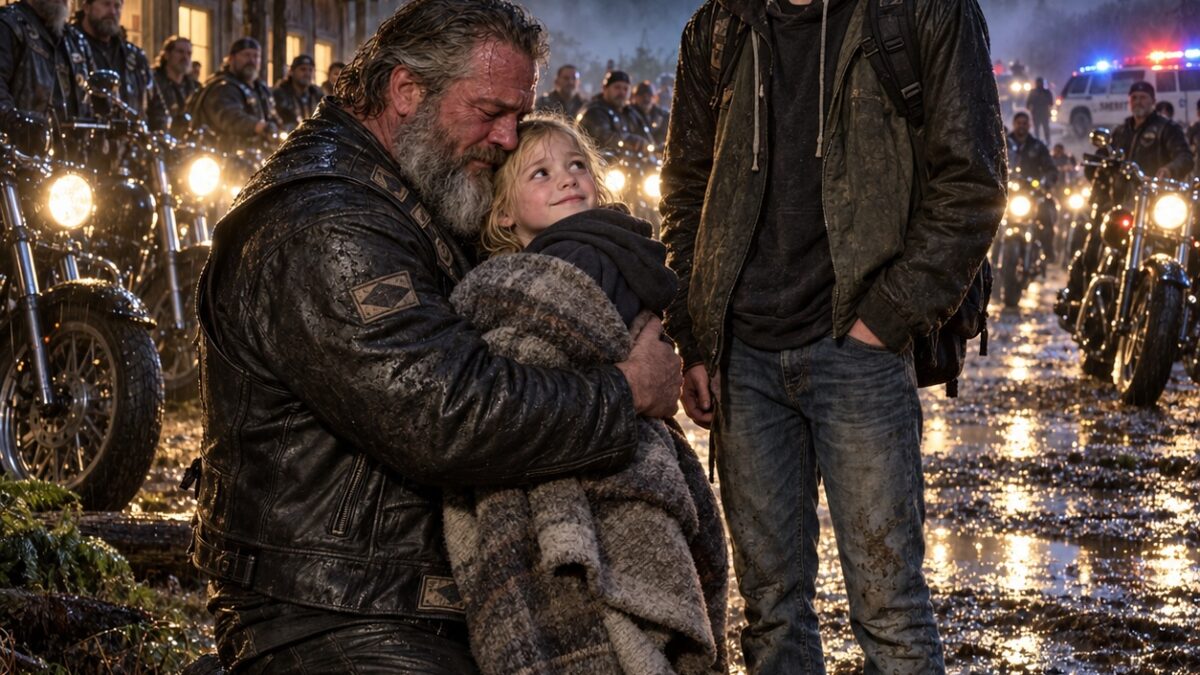
Within minutes, the clearing was surrounded by motorcycles, sheriff’s cruisers and search-and-rescue trucks.
The front door slowly opened.
A huge man stepped inside.
Gray beard.
Soaked leather jacket.
Hands trembling.
Cole Mercer.
He didn’t look at the kidnappers.
He didn’t look at me.
He saw Ellie.
“Daddy!”
She ran.
Cole dropped to his knees.
She hit him so hard they nearly fell backward.
He wrapped both arms around her.
For a long time, he didn’t say anything.
He just held her.
The man I had heard people describe as dangerous cried into his daughter’s wet hair like he didn’t care who saw.
Then Ellie pointed at me.
“He saved me.”
Every person in the room looked my way.
I suddenly remembered what I was.
Runaway.
Foster kid.
Dirty clothes.
No shoes worth calling shoes.
I dropped the fireplace poker.
One of the kidnappers, a man named Travis Kane, immediately pointed at me.
“He was part of it!”
My stomach dropped.
“He called us! He wanted money!”
“That’s a lie,” I said.
But my voice came out weak.
Travis kept talking.
“He had her when we found him!”
I looked at Cole.
His expression was impossible to read.
Then Ellie stepped away from her father.
“No.”
Everybody became quiet.
She pointed at Travis.
“He took me.”
Then she grabbed my hand.
“Mason gave me his shirt. He carried me. He hid me when they came close.”
Cole looked down at my hoodie wrapped around her.
Then at me.
Something in his face changed.
He walked toward Travis.
For one second, I thought I was about to see something terrible.
Instead, Cole stopped several feet away.
Then turned toward Sheriff Daniel Ruiz.
“You heard my daughter.”
The sheriff nodded.
“I did.”
Cole pointed toward the three men.
“Then take them.”
That was it.
No revenge.
No beating.
Just handcuffs.
Evidence.
Witnesses.
Later police found the van stuck on an abandoned logging road.
Inside were zip ties, blankets, food wrappers and items linking the men to the kidnapping.
Travis had once been connected loosely to the Black Ridge Riders but had been expelled after stealing money.
He wanted revenge against Cole.
Ellie had been the easiest way to hurt him.
I thought that was the end of my part in the story.
I was wrong.
A detective walked toward me.
“Mason Reed?”
Hearing my full name scared me more than the kidnappers had.
I backed away.
“How do you know me?”
“You’re listed as a runaway.”
My entire body went cold.
“No.”
“Mason—”
“I’m not going back.”
“You need medical attention.”
“I’m fine.”
I started looking for an escape route.
Cole noticed.
“What’s wrong?”
The detective answered.
“He’s in state custody.”
Cole looked at me.
“You ran from foster care?”
I said nothing.
Ellie answered for me.
“He lives in the woods.”
Cole’s face tightened.
A paramedic wrapped a blanket around my shoulders.
I didn’t want it.
It felt too much like being captured.
Sheriff Ruiz crouched so we were eye level.
“Tell me why you ran.”
I almost lied.
Then I looked at Ellie.
She had trusted me when she had every reason not to trust anybody.
So I told the truth.
Earl Watkins.
The locked rooms.
The threats.
The times social workers came and I was too frightened to speak.
The sheriff didn’t interrupt.
Neither did Cole.
When I finished, Cole asked:
“Anybody investigate that house?”
The detective looked uncomfortable.
“There were prior complaints.”
That sentence broke something inside me.
“Prior complaints?”
Nobody answered.
I started laughing.
Not because anything was funny.
Because I had spent seven months thinking I was crazy.
Thinking nobody would believe me.
And someone had complained before I ever arrived.
Cole turned to Sheriff Ruiz.
“He does not go back there.”
“He won’t,” Ruiz said.
I looked at him.
“You promise?”
“Yes.”
That was the first promise from an adult I believed in a long time.
The investigation into my foster placement began the next day.
Two former foster kids came forward.
Then another.
Earl’s license was suspended while the state reviewed the home.
I was placed temporarily with an emergency foster family.
Not Cole.
That mattered.
The real world has rules.
You don’t save a biker’s daughter on Friday and magically become his son on Saturday.
But Cole showed up.
Every week.
Sometimes with Ellie.
Sometimes alone.
He brought food the first time.
I expected money.
Instead he brought a backpack.
Inside were socks.
A winter coat.
A flashlight.
Three books.
And a cheap prepaid phone.
“What’s this?”
“So you can call somebody next time before living seven months in a forest.”
I almost smiled.
“You always this bossy?”
“Yes.”
Ellie answered from behind him:
“Very.”
Months passed.
The kidnapping case moved toward trial.
I testified.
So did Ellie.
The three men eventually accepted plea agreements carrying long prison sentences.
My old foster placement was permanently closed.
The state opened reviews into several earlier complaints that had been poorly handled.
None of that fixed my childhood.
But it proved I hadn’t imagined it.
That mattered more than people understand.
Cole and I got to know each other slowly.
He owned a motorcycle repair shop.
The Black Ridge Riders helped run it.
I started sweeping floors after school.
Then changing oil.
Then rebuilding carburetors.
Machines made sense to me.
Broken parts didn’t lie.
They showed you exactly where they had failed.
A year later, my foster family decided to move out of state.
I panicked.
I had finally stopped sleeping with my shoes beside the bed.
I couldn’t start again.
My caseworker asked where I wanted to go.
For the first time in my life, somebody actually asked.
I said:
“I want to stay in Pine Crossing.”
She nodded.
“Anyone here you trust?”
I looked through the office window.
Cole sat outside with Ellie.
She was kicking her feet against the chair.
He was pretending not to be nervous.
“Yes.”
That began another mountain of paperwork.
Background checks.
Home studies.
Court hearings.
Training.
Cole complained constantly.
He attended every single meeting.
Six months later, I moved into the spare bedroom above the garage at his house.
Not adopted.
Not yet.
But safe.
The first night, I couldn’t sleep.
My door didn’t have a lock from the outside.
That sounds like a small thing.
It wasn’t.
I lay awake staring at it.
Around midnight, Cole knocked.
“You okay?”
“Yes.”
He started to leave.
“Cole?”
“Yeah?”
“Thank you.”
He stood there awkwardly.
Then said:
“Get some sleep, kid.”
Two years later, the court finalized my adoption.
I was seventeen.
The judge asked whether I understood what adoption meant legally.
I said yes.
But what it meant emotionally was harder to explain.
It meant my backpack could stay unpacked.
It meant nobody measured my worth by whether a placement worked out.
It meant when Cole said “home,” he meant a place that still belonged to me after an argument.
Ellie was eight by then.
She introduced me to everyone as her brother.
Nobody corrected her.
Neither did I.
I’m twenty-nine now.
I still live in Oregon.
I run the service department at Cole’s shop.
Ellie is in college studying social work.
She says she wants to work with foster kids.
I told her that sounds exhausting.
She said:
“You carried me through a freezing forest. You don’t get to complain about exhausting.”
Fair.
Cole has slowed down.
Gray beard almost white now.
Still rides.
Still refuses to admit his knees hurt.
Every October, the Black Ridge Riders hold the same charity barbecue where Ellie disappeared.
But now half the money goes to runaway and foster youth programs.
We keep emergency backpacks there.
Coats.
Phones.
Bus cards.
Food.
There is one rule printed on the volunteer sheet:
BELIEVE THE KID FIRST. INVESTIGATE SECOND.
Cole wrote it.
The funny thing is, people still tell the story wrong.
They say hundreds of bikers rode into a storm and rescued a little girl.
That happened.
But it isn’t the whole story.
A frightened little girl trusted a homeless boy.
That boy trusted a phone number.
A feared biker trusted the police enough not to take revenge.
A sheriff trusted a runaway enough to listen.
And eventually, a kid who had spent years believing family meant whoever the state assigned to him learned something different.
Family isn’t always blood.
It isn’t paperwork either.
Sometimes family begins in the worst night of your life.
Someone looks at you cold, hungry and terrified…
and instead of asking what is wrong with you,
they ask what happened to you.
Then they stay long enough to hear the answer.
I entered that forest believing invisible was the safest thing a person could be.
I came out surrounded by hundreds of headlights.
For the first time in my life, people were looking for me too.
And I wasn’t afraid to be found.