If you’ve ever owned a dog, you’ve probably experienced it.
Your dog does something completely ridiculous.
You laugh.
Then, a few moments later, the dog does it again.
It can almost feel as though your pet knows exactly what made you laugh and is deliberately giving you an encore.
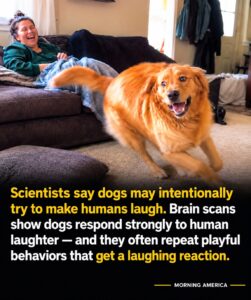
But can dogs really understand our laughter?
The scientific answer is more complicated — and perhaps even more interesting.
Researchers studying canine behavior have found strong evidence that dogs are remarkably sensitive to human communication, including our voices, facial expressions and emotional signals.
Brain-imaging research has also provided scientists with fascinating clues about how dogs process sounds.
Studies using functional MRI have found specialized voice-sensitive regions in dogs’ brains and shown that canine brains respond differently depending on the emotional qualities of sounds.
That’s important because dogs have lived alongside humans for thousands of years.
During that time, they have become exceptionally skilled at watching us.
They notice our tone of voice.
They watch our faces.
They learn our routines.
And they can associate their own behavior with the reactions they receive from people.
Imagine that your dog grabs a toy, runs wildly around the living room and makes everyone laugh.
If the laughter is followed by attention, affection or more play, the dog may learn that this particular behavior produces a rewarding response.
The next time the dog wants attention, it might try the behavior again.
Does that mean dogs possess a human-style sense of humor and consciously think, “I’m going to tell a joke now”?
Scientists haven’t established that.
That’s an important distinction.
But dogs don’t need to understand humor exactly as humans do to learn which actions produce happy reactions.
This ability may help explain why some dogs appear to develop their own funny little routines.
One dog might dramatically roll onto its back.
Another might steal a sock and wait for someone to chase it.
Another may race around the house whenever its owner starts laughing.
To us, these behaviors can look like comedy.
To the dog, they may be part of a social interaction that has repeatedly resulted in attention and positive emotions.
And that may be one of the reasons humans develop such strong relationships with dogs.
They aren’t simply living beside us.
They’re constantly watching, listening and learning from us.
Scientists still have plenty to discover about what dogs understand about human emotions and whether anything resembling intentional humor exists in canine minds.
But one thing is increasingly clear:
Your dog pays much more attention to your reactions than you might realize.
So the next time your dog does something hilarious, watches you laugh and immediately does it again…
Maybe that second performance isn’t entirely an accident. 🐶❤️😂