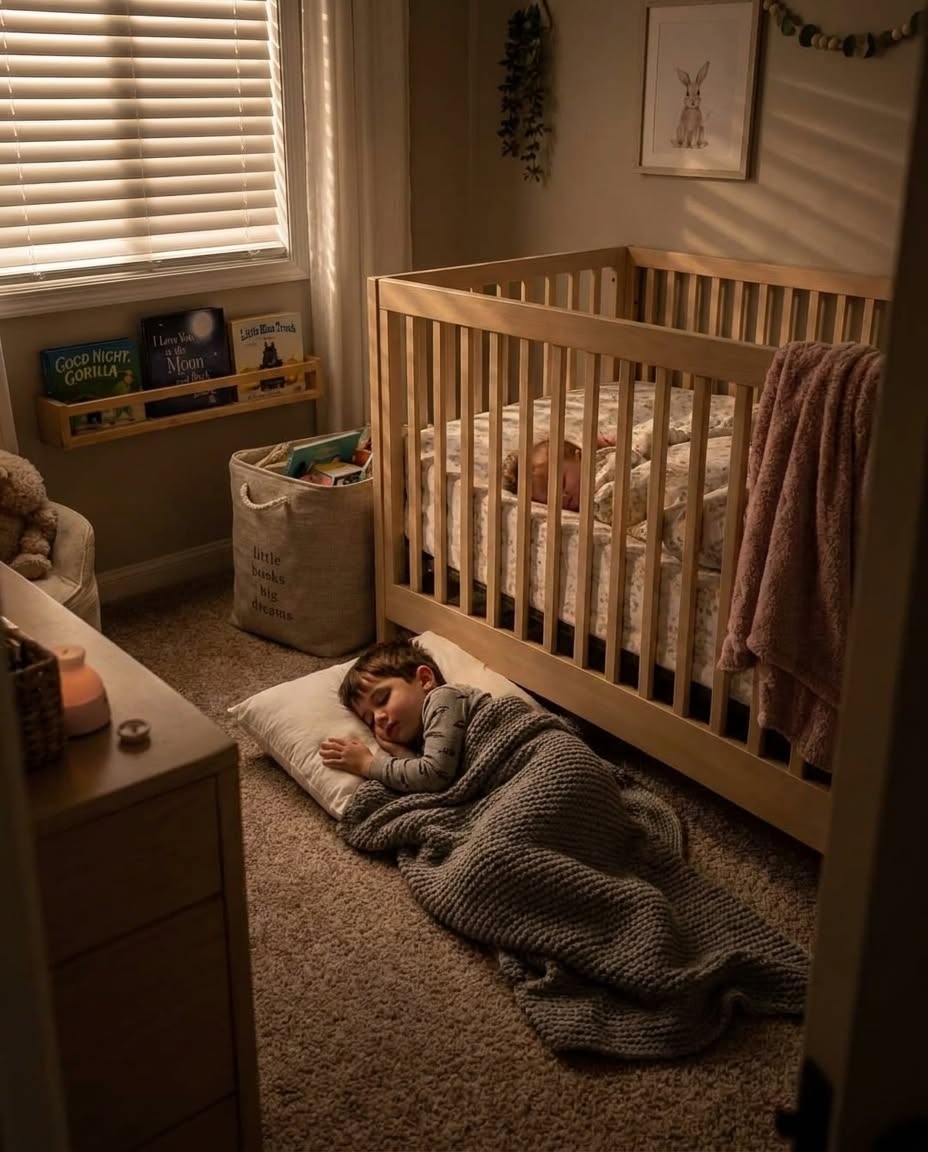
At a little after two in the morning, the baby monitor crackled beside my bed and carried a whisper that made me sit straight up. “I won’t fall asleep this time,” my seven-year-old son, Ben, said softly. “I promise. I won’t let Grandma do it again.” I slipped into the hallway and found him lying beneath his newborn sister Brenda’s crib, one hand wrapped around the bottom rail, his eyes wide open in the dark. For two weeks I had been finding him there every morning and gently sending him back to his own bed, assuming he was simply an overprotective big brother who had waited years for a sibling. Now his face went pale when he saw me. When I asked what he meant, he started crying and whispered that Grandma Diane had made him promise not to tell. In that moment, every sweet explanation I had given myself for his behavior disappeared.
Ben had begged for a sibling for nearly three years, and when Brenda was born, his devotion to her was immediate. Brenda’s Down syndrome diagnosis overwhelmed Daniel and me with appointments, specialists, insurance questions, and fears about a future we could not yet picture, but Ben looked at her once and simply said, “She’s perfect.” Diane, my mother-in-law, had moved in temporarily to help with meals, laundry, errands, and school pickups, and at first her presence felt like a gift. Over time, however, her comments changed. She warned that Brenda might become “too much,” suggested that love might not be enough, and repeatedly spoke about the toll our daughter could someday take on Ben, our marriage, and our finances. I heard those remarks as anxiety from an older generation struggling with disability. Ben heard something else. Whenever Diane approached the crib, he appeared nearby, quiet and watchful. When I finally listened to him that night, I understood why.
Diane had been entering the nursery after everyone was asleep and deliberately waking Brenda. According to Ben, she would unwrap her swaddle, switch on the bright light, touch her feet and face, and keep stimulating her until the sleeping newborn began crying hard. Then Diane would carry her into our bedroom and claim Brenda had awakened on her own and was impossible to settle. Ben had witnessed it and confronted his grandmother, only to be told that Daniel and I needed to understand what our future would really be like and that telling us would only upset me. So he began sleeping beneath the crib because Diane would leave Brenda alone if she knew someone was watching. The nights he failed to stay awake were the nights she succeeded. When I later called a relative named Carol, another piece fell into place: Diane had also been quietly asking whether Carol and her husband might someday consider raising Brenda if Daniel and I became overwhelmed. She had not arranged an adoption or created any legal plan, but she had already begun constructing the argument that our daughter belonged somewhere else.
Daniel and I confronted Diane, documented what Ben had told us, contacted Brenda’s pediatrician, and sought advice about keeping Diane away from the children. Brenda was medically fine, which brought enormous relief, but the breach of trust was unmistakable. Diane eventually admitted that she had wanted us to “feel” how difficult life with Brenda could become so we would consider other options before becoming, in her words, too attached. That explanation ended any ambiguity. Whether or not every action met a criminal standard was for authorities to determine; as parents, our immediate responsibility was safety. Diane left our home, and any future contact became tightly controlled and supervised. More importantly, we sat Ben down and corrected the burden an adult had placed on him. We told him that no adult was ever allowed to ask him to keep a frightening secret from his parents, especially by claiming he was protecting us. He was seven years old. Guarding his sister through the night had never been his job.