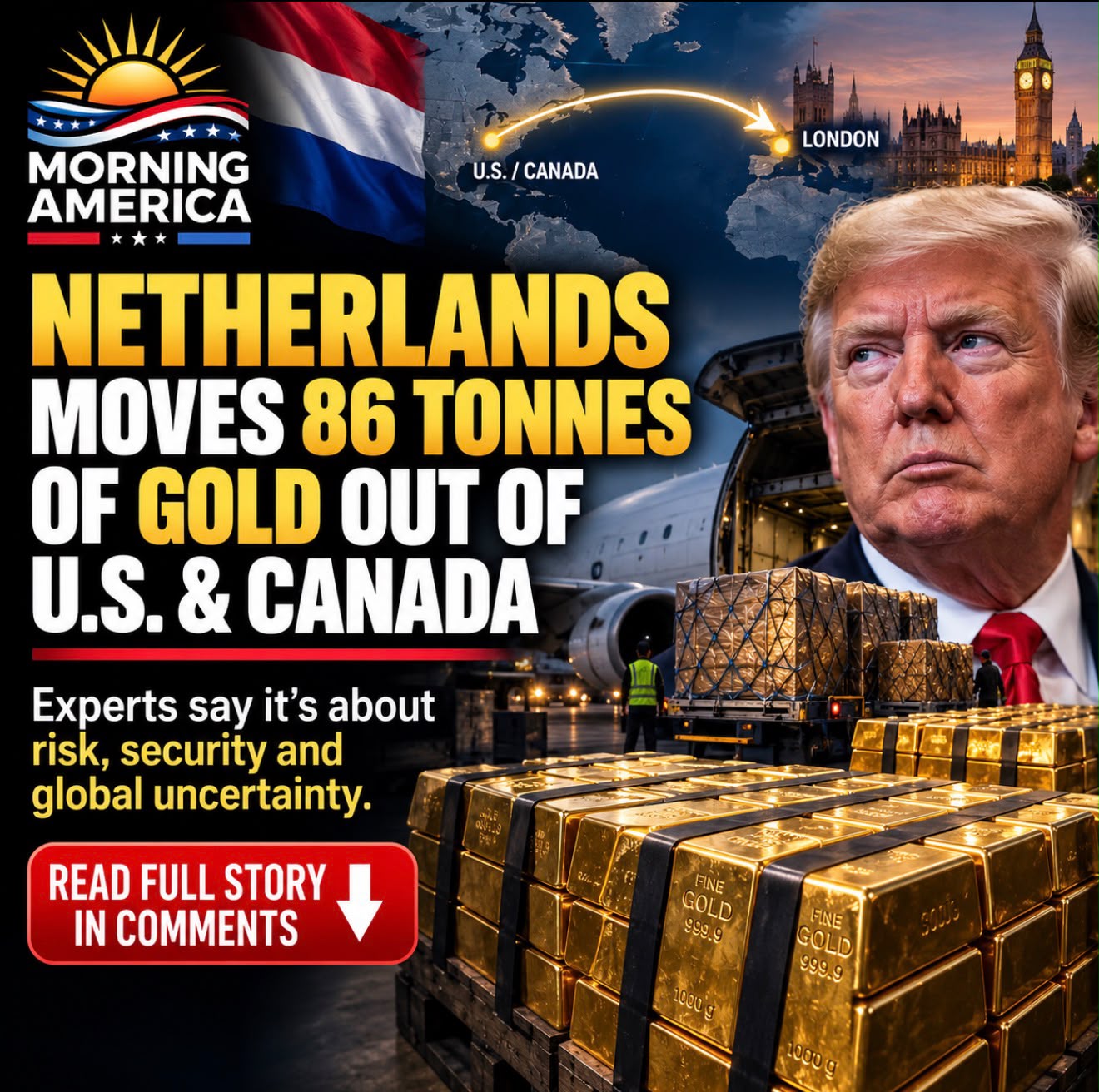
Billions of dollars in Dutch gold quietly changed homes this year, moving across the Atlantic as concern grew over an increasingly unsettled geopolitical landscape. Between March and August, De Nederlandsche Bank relocated roughly 86 tonnes of sovereign bullion away from vaults in New York and Ottawa and increased the share held in London. The shift dramatically reduced the proportion of Dutch gold stored with the Federal Reserve Bank of New York, from 31.3 percent of total reserves to 18.5 percent. At the same time, the Bank of England became the Netherlands’ largest foreign gold custodian, holding 32.1 percent of the country’s stockpile. Officially, the move was described as a way to improve liquidity and crisis preparedness. Yet in financial circles, the timing has invited a much more pointed question: why reduce exposure to the United States now?
The Dutch central bank has framed the decision in practical terms. Gold held in London is easier to trade quickly in a severe financial emergency, making the city attractive for a country trying to maintain flexibility during periods of market stress. DNB also cited “increasing geopolitical unrest” and the need to be better prepared for serious crises. But the relocation comes as European policymakers face growing uncertainty over trade disputes, tariff threats, and the broader direction of Washington’s economic and foreign policy under President Donald Trump. Some observers have interpreted the move as part of a wider effort by European institutions to reduce reliance on financial infrastructure concentrated in the United States. The bank itself has not publicly characterized the transfer as a political rebuke, but the surrounding climate has ensured that the operation is being viewed through that lens.
That interpretation became sharper when Dutch financial commentator Johan de Ruiter publicly argued that keeping national wealth in the United States had become too risky. He warned that European gold should be moved out of American custody as quickly as possible, saying it was “simply no longer safe there.” The concern is not necessarily that physical bullion is in immediate danger, but that foreign reserves can become entangled in political, legal, or financial restrictions during periods of severe diplomatic conflict. Central banks manage reserves partly through diversification, liquidity, jurisdictional risk, and access during emergencies, so even a relatively low-probability scenario can influence where strategic assets are stored. Against that backdrop, the Dutch decision looks less like an isolated logistics exercise and more like a hedge against uncertainty. The distinction between precaution and distrust may ultimately be impossible to separate completely.
The mechanics of moving so much bullion were themselves unusually complex. Rather than transporting all 86 tonnes physically across the Atlantic, DNB reportedly used a hybrid approach designed to reduce insurance, security, and transportation exposure. Around 59 tonnes of gold held in New York were sold and replaced with standard bullion purchased in London, while approximately 27 tonnes were physically transferred through high-security channels involving the bank’s domestic storage facility in Zeist. That strategy allowed the Netherlands to alter the geographic distribution of its reserves without placing the entire shipment at risk in a single transatlantic operation. With total Dutch gold holdings valued at more than €72 billion, even a modest change in custody represents a major balance-sheet decision. Reserve management at this scale is rarely impulsive; it reflects calculations about liquidity, counterparty exposure, jurisdiction, and the ability to act quickly if markets or governments become unstable.
What makes the move significant is not simply that gold changed vaults, but that it reflects how governments think about trust during uncertain periods. Central-bank reserves are designed for moments when ordinary assumptions fail—banking shocks, currency stress, conflict, sanctions, or sudden breaks between allies. The Netherlands has not said that America is unsafe in any absolute sense, nor has it officially tied the decision solely to Trump. But shifting such a large quantity away from North America while emphasizing geopolitical risk sends its own message about diversification. Gold is often described as a store of value, yet where that gold is stored can be just as strategic as how much is owned. In an era when financial systems themselves can become tools of state power, the location of a nation’s reserves has become part of the security calculation.