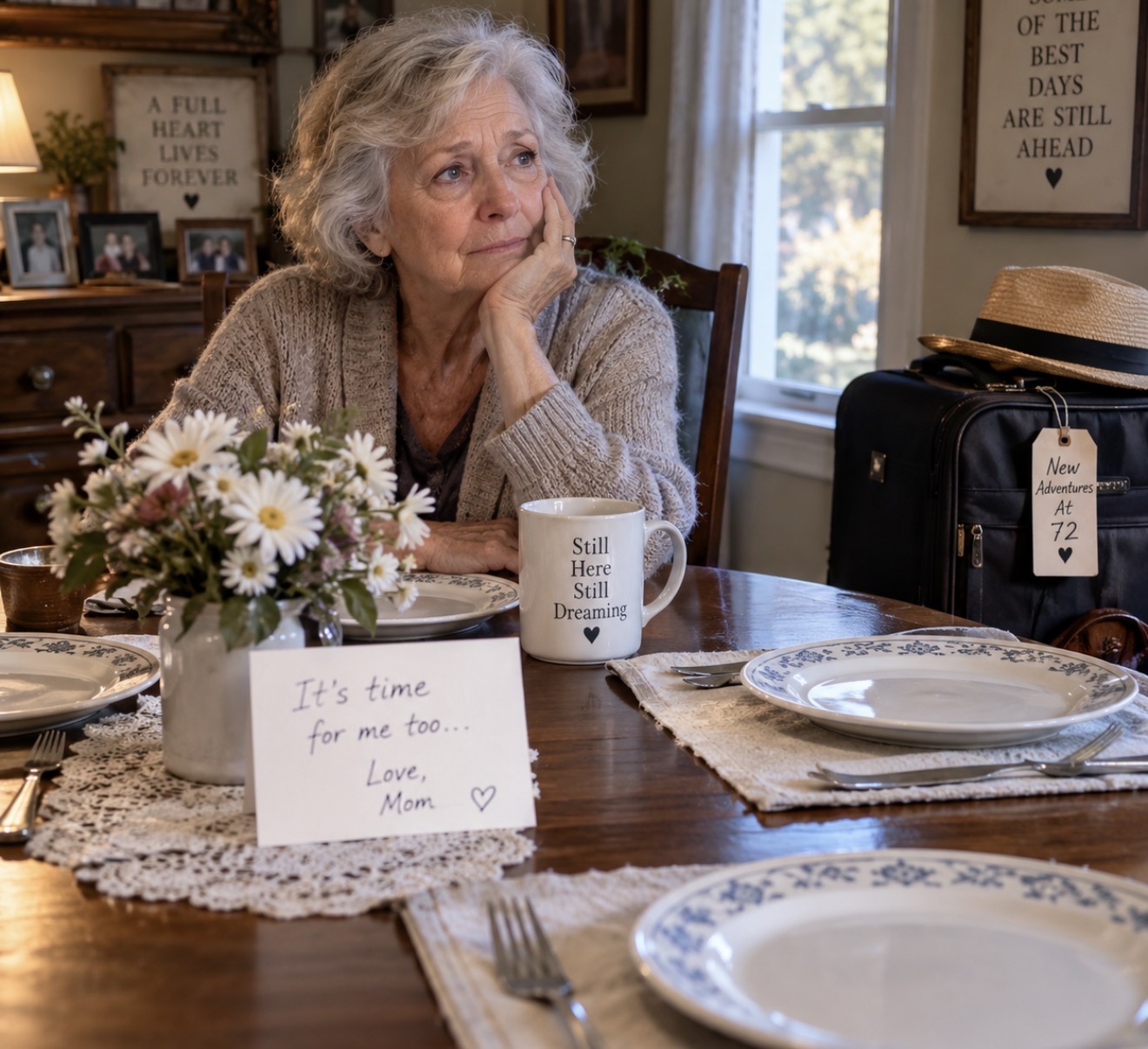
At 72, Margaret had developed one habit she could never quite bring herself to break.
Every Sunday morning, she set the dining table for four.
One plate for herself. Three more for the people she loved most.
Her daughter, Emily, lived two hours away with her husband and two children. Her son, Daniel, had moved across the state years earlier for work.
They had busy lives now. Margaret understood that.
At least, that was what she kept telling herself.
“They’ll call when things slow down,” she would whisper while straightening the napkins.
Sometimes Emily promised to visit.
“Maybe Sunday, Mom. I’ll let you know.”
Daniel usually said something similar.
“This month is crazy. I’ll make it up to you.”
Margaret never complained.
She had spent most of her life taking care of other people. She had raised two children, worked for more than thirty years, cared for her husband during the final years of his life, and somehow kept the family together through every difficult season.
After her husband passed away, the house became painfully quiet.
But Sundays were different.
Sunday had always been family day.
For years, the house had been filled with laughter, children running through the hallway, dishes clattering in the kitchen, and her husband pretending he wasn’t sneaking pieces of dessert before dinner.
Margaret refused to believe those days were completely gone.
So she kept setting the table.
And she kept waiting.
One Sunday became another.
Weeks became months.
Occasionally, her children called. They loved her—Margaret never doubted that.
But the conversations became shorter.
“Mom, can I call you later?”
“I’m running into a meeting.”
“The kids have practice.”
“We’re exhausted.”
There was always something.
Margaret always answered the same way.
“Of course, sweetheart. Don’t worry about me.”
Then came one particular Sunday morning.
Margaret woke early and prepared the meal her children had loved growing up.
She roasted chicken, made potatoes, and even baked an apple pie.
At noon, everything was ready.
At 12:30, nobody had arrived.
At 1:00, Margaret checked her phone.
Nothing.
At 1:17, a message finally appeared from Emily.
“Sorry, Mom. We can’t make it today. Something came up.”
A few minutes later, Daniel sent another message.
“Crazy weekend. Rain check?”
Margaret stared at the screen.
Normally, she would have typed the same response.
“No problem. Love you.”
But that afternoon, she didn’t.
She looked across the table at the three empty chairs.
Then she noticed something she had somehow ignored for years.
Her own chair was empty too.
Margaret was standing in the kitchen waiting for everyone else to start living with her again.
And suddenly she asked herself a question:
“How much of my life am I willing to spend waiting?”
She turned off the oven.
She wrapped the food and put it in the refrigerator.
Then Margaret walked upstairs.
At the back of her closet was an old black suitcase.
It had belonged to her husband.
She hadn’t touched it in years.
Inside one of its pockets was a faded travel brochure they had picked up almost three decades earlier.
They had always dreamed of traveling together after retirement.
There was always a reason to postpone it.
The mortgage.
College.
Work.
Family responsibilities.
Then her husband’s health declined.
The trip never happened.
Margaret sat on the edge of the bed holding that old brochure.
For the first time in months, she smiled.
She opened her laptop.
And she booked a trip.
Not next year.
Not “someday.”
She was leaving that week.
Margaret packed slowly.
Before walking out of the house, she returned to the dining room one last time.
The plates were still sitting on the table.
She removed three of them.
Then she took a piece of paper and wrote a short note.
“I spent my life making sure everyone I loved had somewhere to go and someone waiting for them.
I forgot that I still have a life of my own.
I love you.
But I’m done waiting.
It’s time for me too.
Love,
Mom.”
She left the note on the table.
Then she picked up her suitcase and walked outside.
Two days later, Emily called.
Then Daniel.
Their mother wasn’t answering.
At first, they assumed she was busy.
Then Emily drove to the house.
She used the spare key Margaret had given her years earlier and stepped inside.
“Mom?”
Silence.
She walked into the dining room.
That was where she found the note.
Emily read it once.
Then again.
By the third time, she was crying.
She called her brother.
“Daniel… Mom left.”
“What do you mean, left?”
Emily read him the note.
There was silence on the other end.
Then Daniel said something neither of them wanted to admit.
“We kept assuming she’d always be there.”
Meanwhile, hundreds of miles away, Margaret was sitting beside a window watching a sunset in a place she had dreamed of seeing for decades.
Her phone was beside her.
She saw the missed calls.
She wasn’t angry.
She wasn’t trying to punish anyone.
She simply wasn’t ready to rush back into the old routine.
For once, Margaret wanted to finish watching the sunset.
Later that evening, she called her children.
Emily answered immediately.
“Mom! Where are you?”
Margaret laughed.
“I’m exactly where I want to be.”
There were apologies.
There were tears.
And there was a long conversation that probably should have happened years earlier.
Margaret told them she loved them.
But she also told them something important.
“Being your mother is one of the greatest parts of my life. But it cannot be the only part of my life.”
Her children understood.
Something changed after that.
They began calling more often—not because Margaret demanded it, but because they finally understood how easily “later” can become years.
And Margaret?
She never returned to waiting beside an empty table.
She traveled.
She joined a local walking group.
She made new friends.
She started painting again, something she hadn’t done since her twenties.
And Sunday dinners eventually returned.
But there was one important difference.
Margaret no longer built her entire week around whether someone else showed up.
At 72, she finally understood something many people spend their whole lives learning:
Loving your family does not mean putting your own life on hold forever.
Sometimes the most powerful decision isn’t walking away from the people you love.
It’s remembering that you deserve to keep living too.
And sometimes an empty chair isn’t the end of a story.
Sometimes it’s an invitation to begin a new one. ❤️