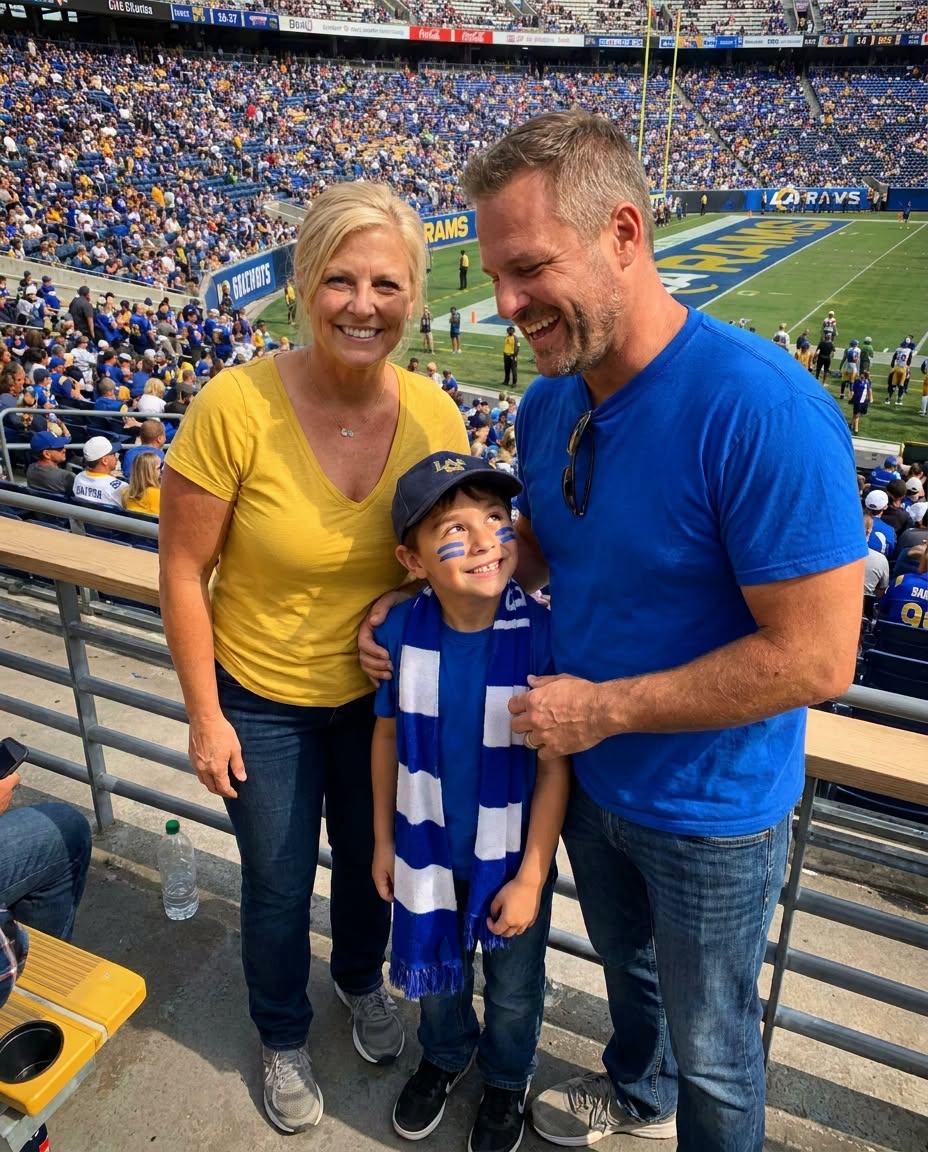
Our ten-year-old son was laughing so hard beneath the stadium lights that, for one impossible moment, he looked like every other child in the crowd. Ethan’s face appeared forty feet tall on the giant screen between mine and Chris’s, his oversized blue jersey hanging loosely from shoulders that had grown thinner over the past few months. He shouted, “We’re famous!” while strangers around us laughed and waved. I lifted my phone automatically, already taking another picture to add to the thousands I had collected since his doctors told us the cancer was no longer responding to treatment. Then the announcer said Ethan’s name. “There’s something you don’t know about this trip,” the voice boomed across sixty thousand people. We were told to turn around. Coming down the concrete steps toward us were people from the hospital carrying Ethan’s battered tabletop football game—and beside them was a man my husband had spent months avoiding.
Three months earlier, our life had still been ordinary enough for Sunday football to mean Chris yelling at the television, Ethan correcting him, and me accusing referees of crimes I could not technically explain. Then doctors told us that treatment had failed. Chris responded by trying to solve the unsolvable: insurance calls, experimental-treatment research, binders full of medical information, late-night searches for trials and specialists. I responded differently. I started documenting everything. Breakfasts. Hospital bracelets. The way Ethan slept with one sock missing. His voice complaining about hospital food. His laughter. I upgraded cloud storage because preserving him began to feel like a job I could perform when there was nothing else I could fix. When a wish organization asked Ethan what he wanted most, he did not ask to meet a famous player or take a spectacular trip. He wanted one real football game with Mom and Dad. What we did not know was that he had made another request too: he wanted the people from the hospital who still treated him like an ordinary kid to be part of the day.
That was why Ray from hospital facilities arrived carrying the little plastic football field Ethan had turned into his unofficial hospital league. Nurses played. Other young patients played. Even doctors who wandered too close were assigned a tiny plastic player because Ethan had one absolute rule: “Everybody plays. Nobody just watches.” With Ray came a teenager named Cody, a nurse from Ethan’s floor, and Leo, another father from the oncology ward. Months earlier Leo had received the news every parent there dreamed of—his son’s scans were clean—and Chris had encountered him celebrating in the hallway minutes after learning another treatment had failed Ethan. Overwhelmed by grief, Chris snapped at him to celebrate somewhere else and then spent months too ashamed to apologize. Ethan had witnessed the exchange. Leo later began quietly visiting Ethan’s room to play tabletop football, never holding Chris’s cruelty against the child. Now, standing in the stadium, Ethan had unknowingly brought those two fathers back into the same space. But the larger surprise was aimed at us. When the announcer repeated Ethan’s rule—“Everybody plays”—I raised my phone again. Ethan stopped smiling and stared directly at the screen between us.
In a quiet family room beneath the stadium, our son finally explained what we had been too frightened to see. Chris no longer watched football; he watched Ethan watching football, constantly checking whether he was tired, cold, hurting, or breathing differently. I photographed cereal because every breakfast felt like something that might one day be gone. Ethan told us that everyone had started treating ordinary life as though it were already a memorial. “I wanted you guys to have fun with me,” he said. “Not fun about me. With me.” Then came the sentence that rearranged everything: “Sometimes I just want stuff to be stuff.” In trying to preserve every remaining moment, we had made every remaining moment heavy. Chris apologized for guarding the clock instead of living inside it. When Leo later appeared at the doorway, Chris finally asked how his son was doing and genuinely listened to the answer without turning another family’s good news into evidence of our own loss. From a medical standpoint, nothing had changed. Ethan’s prognosis was still what it was. But the emotional terms of the time remaining changed completely.
We returned to our seats for ten more minutes because that was what Ethan wanted. No announcements followed. No cameras found us. Chris complained loudly about a bad play and, for once, forgot to check Ethan’s face afterward. When a referee threw a flag, I jumped up and shouted with the same irrational conviction I had before cancer entered our vocabulary, and Ethan doubled over laughing. My hand moved toward my phone, trained by months of fear, then stopped. “You’re not taking one?” Ethan asked. “No,” I said. “I’m watching.” Late in the fourth quarter, our team scored and all three of us rose with the crowd, yelling and grabbing one another while one tiny plastic player fell from Ethan’s tabletop game and landed beneath my seat. I saw it and left it there. For once, I did not fix the small thing or capture the big thing. I simply stayed inside the moment while my son laughed. Of all the photographs and recordings I still have, the memory I return to most is the one I never saved: the afternoon Ethan taught his frightened parents that love is not only in preserving what will be lost. Sometimes love is putting the camera down and joining the game while there is still time to play.