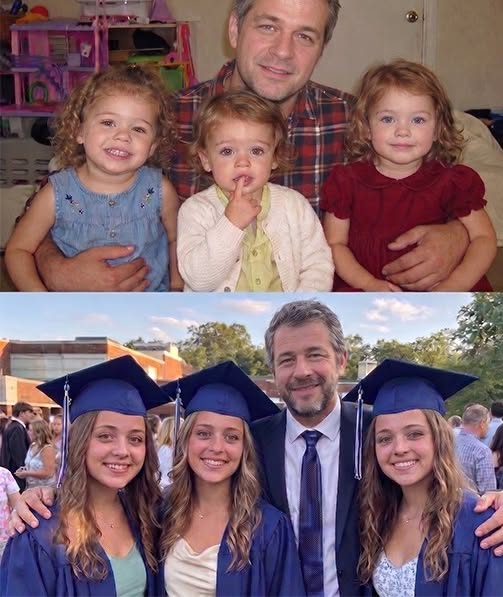
There were many nights when I questioned whether I was doing enough-
or getting anything right. Looking back now, I can trace the life we built to
one decision I made on an ordinary October evening, when I found 3
babies beneath my flickering porch light.
I had just returned from a double shift at Brennan’s Hardware, smelling of
sawdust and machine oil, when I nearly tripped over 3 infant car seats outside
my apartment.
A diaper bag sat between them. Tucked beneath its strap was a gas-station
receipt covered in my brother Matthew’s handwriting.
I’m sorry, Owen. I can’t do this. They’re safer with you.
That was all.
His wife, Rebecca, had di:ed unexpectedly 11 days earlier. Their triplet
daughters were only 6 months old.
I was 27, unmarried, and living above the hardware store. I had $312 in my
checking account, almost nothing in the refrigerator, and a futon that refused to
unfold properly.
One of the babies began to cry.
I knelt beside the car seats. The smallest girl was awake, watching me with gray
eyes that reminded me of my mother.
Before I could decide what to do, my neighbor, Mrs. Delgado, stepped onto the
landing in her purple bathrobe.
“Owen, why are there babies on your porch?”
“They’re Matthew’s.”
“Where is he?”
I handed her the receipt.
She read it, closed her eyes, and muttered something in Spanish.
“You need to call the police and child services.”
“I know.”
“You can’t raise 3 babies alone.”
“I know that, too.”
“You don’t even know how to warm a bottle.”
She was right.
Then the smallest baby reached upward, her fingers opening and closing. I
offered her my index finger, and her tiny fist wrapped around it.
“That’s Nora,” Mrs. Delgado said softly. “The baby with the birthmark behind her
ear is Lily, and the loud one is Sadie.”
Nora held on as though she had already decided I belonged to her.
She didn’t know I was broke or frightened. She didn’t know her mother was
gone or that her father had abandoned her.
She only knew someone was there.
“There are good foster families,” Mrs. Delgado said carefully. “People who are
prepared for this.”
I opened my mouth to agree.
Instead, I looked at the 3 girls and whispered, “Okay. I’ve got you.”
That night, I stopped being only their uncle.
I just didn’t have another name for what I had become yet.
The police found Matthew’s car at a bus terminal the following morning. Nine
days later, he contacted them from Arizona. He was alive, but he had no
intention of returning.
A social worker named Ms. Kim inspected my apartment.
“You don’t have enough space,” she said.
“I’ll move.”
“You work more than 60 hours a week.”
“I’ll change my schedule.”
“Can you afford childcare for 3 infants?”
“No,” I admitted. “But I’ll find a way.”
She studied me for a long moment.
“Why do you want to do this?”
I looked at the girls sleeping in 3 separate bassinets donated by Mrs. Delgado’s
church.
“They already lost their mother,” I said. “I won’t let them lose everyone else.”
Emergency kinship placement brought parenting classes, background checks,
home inspections, and stacks of paperwork.
The girls qualified for survivor benefits through Rebecca, and the county
provided a small kinship-care allowance. It wasn’t enough to make life
comfortable, but it helped cover formula and childcare.
Mr. Brennan moved us into a vacant 2-bedroom apartment behind the store and
lowered the rent. Mrs. Delgado taught me how to prepare bottles, change
diapers, and identify which cry belonged to which baby.
Six months later, a judge granted me permanent guardianship.
Adoption was more complicated. Matthew had disappeared without legally
surrendering his parental rights. A family-law attorney warned me that
terminating them could mean an expensive court battle.
I told myself guardianship was enough.
The truth was that I also worried adopting the girls would erase Rebecca-or
that Matthew might return and accuse me of stealing his family.
He never did.
The girls called me Uncle Owen until they were nearly 4. Then Sadie fell from a
climbing frame at the park and screamed, “Daddy!”
I ran to her before realizing she meant me.
Soon Lily and Nora began calling me Dad, too.
No one held a family meeting about it.
One day I was Uncle Owen.
The next, I was simply Dad.
Twenty-two years passed slowly while I lived them and far too quickly once they
were gone.
I packed lunches with the wrong bread. I forgot picture day twice. My attempts
at braiding their hair were so awful that Mrs. Delgado began waiting on the
porch every morning with a brush.
“You’re going to give those girls a lifelong fear of mirrors,” she told me once.
“I’m doing my best.”
“I know. That’s what worries me.”
I worked double shifts when the girls needed braces, glasses, science-project
supplies, or new shoes. When I couldn’t repair their broken hearts, I made
grilled cheese and sat beside them on the couch.
There were difficult years, too.
At 13, Nora slammed doors.
At 15, Lily barely spoke to me for a month.
At 17, Sadie shouted that I didn’t understand anything about her.
She was right.
I didn’t always understand, but I stayed.
That was the one promise I knew how to keep.
I gave up vacations, friendships, and chances I couldn’t get back.
I also lost Elise, the woman I loved.
She had been patient with my unpredictable schedule and loved the girls, but
after 4 years, she stood outside my apartment holding an overnight bag she had
never carried inside.
“I’m not asking you to choose between us,” she said. “I’m asking whether there’s
room for me.”
I looked toward the apartment, where 3 girls were waiting.
“There isn’t,” I admitted. “Not the kind of room you deserve.”
Elise left a gray sweater behind.
I never returned it.
For years, I told myself I had let her go because the girls needed me. The truth
was that I had become afraid of needing anyone myself.
Matthew appeared occasionally, like bad weather.
A birthday card arrived without a return address. Later, a Christmas card came
from Nevada.
When the girls were 12, he finally called.
“I want to reconnect,” he said. “I’ve been thinking about being their father.”
I gripped the telephone.
“You don’t become their father by thinking about them.”
“I was grieving, Owen.”
“So were they.”
“I made a mistake.”
“A mistake is forgetting a birthday. You left 3 babies outside my door.”
He fell silent.
“If you want to know them, get on a plane and show up,” I said. “Then they can
decide whether they want you in their lives.”
Matthew never came.
The cards stopped after that.
The girls never asked about him, but I carried a fear I couldn’t admit aloud: that
somewhere inside their hearts, they were still waiting for their real father.
When they turned 18, Ms. Kim suggested adult adoption.
“You could ask them,” she said.
I couldn’t.
What if they said no?
I convinced myself the paperwork didn’t matter.
In truth, it mattered too much.
All 3 girls earned scholarships to the same small state college near home. Lily
studied education, Sadie chose accounting, and Nora became a nurse.
On the morning of their graduation, I sat in my truck for 20 minutes before going
inside.
I was 49. My beard had gone gray in patches, and my left knee still hurt from a
fall at the hardware store.
Inside my wallet, I carried Matthew’s original note.
I’m sorry, Owen. I can’t do this. They’re safer with you.
After 22 years, the ink had faded, but the words remained readable.
I folded it carefully, picked up my cheap camera, and entered the auditorium.
Mrs. Delgado sat beside me, now 78 and leaning on a silver cane.
The girls crossed the stage one after another.
Lily began crying before her name finished echoing through the room. Sadie
spotted us and waved with both hands. Nora walked across the stage with the
same quiet determination she had carried throughout her life.
I took pictures of them all.
When Nora accepted her diploma, I finally allowed myself to breathe.
We had made it.
Then the college president returned to the microphone.
“Each year, our graduates may honor someone whose support made their
education possible,” she said. “This year, 3 graduates nominated the same
person.”
My daughters returned to the stage, holding hands.
Nora approached the microphone.
“Our father isn’t standing here with us today,” she began.
My stomach dropped.
Matthew.
After 22 years of absence, were they about to honor the man who had
abandoned them?
I told myself to remain seated and let them say whatever they needed to say.
Then Nora looked directly toward row 7.
“He’s sitting in the audience with a camera he still doesn’t know how to use.”
The room filled with laughter.
I stopped breathing.
Sadie removed a black notebook from beneath her gown.
“We found this in the kitchen drawer,” she said.
I recognized it immediately.
I had begun writing in that notebook on their 1st birthday. Whenever I felt I had
failed them, I wrote down the things I couldn’t say aloud.
Nora opened it.
“To my girls. You are 1 year old today. I don’t know if I’m doing any of this right.
I’m scared most of the time, but I know one thing: I’m not going anywhere.”
A chill ran through me.
I remembered writing those words alone at our warped kitchen table after the
girls had fallen asleep.
My daughters returned to the stage, holding hands.
Nora approached the microphone.
“Our father isn’t standing here with us today,” she began.
My stomach dropped.
Matthew.
After 22 years of absence, were they about to honor the man who had
abandoned them?
I told myself to remain seated and let them say whatever they needed to say.
Then Nora looked directly toward row 7.
“He’s sitting in the audience with a camera he still doesn’t know how to use.”
The room filled with laughter.
I stopped breathing.
Sadie removed a black notebook from beneath her gown.
“We found this in the kitchen drawer,” she said.
I recognized it immediately.
I had begun writing in that notebook on their 1st birthday. Whenever I felt I had
failed them, I wrote down the things I couldn’t say aloud.
Nora opened it.
“To my girls. You are 1 year old today. I don’t know if I’m doing any of this right.
I’m scared most of the time, but I know one thing: I’m not going anywhere.”
A chill ran through me.
I remembered writing those words alone at our warped kitchen table after the
girls had fallen asleep.
Sadie continued:
“I may burn breakfast, forget appointments, and embarrass you in public. But I
promise I will be the one who stays.”
Then Lily read the final lines:
“I didn’t know anyone could love another person as much as I love the 3 of you.
Whatever happens, I am yours.”
The auditorium blurred through my tears.
Nora looked straight at me.
“When I said our father, I meant you, Dad. I have always meant you.”
For 22 years, I had feared the girls were waiting for their real father.
Only then did I understand that they had never been confused about who he
was.
The girls walked down from the stage and handed me 3 blue folders.
With help from a local family-law attorney, they had completed and notarized 3
petitions for adult adoption. Only my signatures were missing.
“We can’t finish them without you,” Nora said. “But if you still want us-”
“Still want you?”
My voice broke.
I saw them as they were and as they had been: 3 infants beneath a flickering
porch light, 3 little girls waiting for me to fix their hair, 3 angry teenagers
slamming doors, and now 3 women asking me to become legally what I had
been in my heart for most of my life.
I pulled them into my arms.
“Yes,” I whispered. “Of course I want you.”
Nora held on with the same fierce grip she had used around my finger 22 years
earlier.
“We just want the paperwork to tell the truth,” she said.
The entire auditorium rose to its feet.
Six weeks later, we stood before a judge.
Because the girls were adults, Matthew’s permission was no longer required.
The judge asked each of them whether she freely consented to the adoption.
All 3 said yes.
Then he asked Nora why they had chosen to do it.
“Because he stayed,” she answered.
The judge signed the final orders.
Afterward, we went to a diner with Mrs. Delgado and ordered 4 grilled cheese
sandwiches. She ordered pie and informed everyone nearby that she had raised
all of us.
No one argued.
Later, I hung 2 frames on the wall.
Matthew’s gas-station receipt went on the left.
The adoption orders went on the right.
The first document recorded the night someone left.
The second recorded everything that happened because I stayed.
For years, I had called my life a sacrifice. Standing before those frames, I finally
understood that it wasn’t.
It was the life I had chosen.
And somewhere along the way, it had chosen me back.
My phone buzzed.
Have you called Elise yet? Sadie had written.
The girls had recently run into Elise, who had moved back to town after her
marriage ended. We had exchanged numbers but hadn’t spoken.
Another message arrived from Nora.
You’re allowed to have a life, too, Dad.
I smiled and called Elise.
When I asked if she wanted to meet for coffee, she was quiet for a moment.
“Coffee would be a good place to start,” she said.
A year later, all of us gathered for dinner above the hardware store. Lily brought
her fiance. Sadie arrived late from work. Nora came directly from the hospital in
her nursing scrubs. Elise sat beside me, and Mrs. Delgado occupied the chair at
the head of the table.
Outside, a moth passed beneath the porch light, making it appear to flicker.
Nora noticed and smiled.
“Do you remember the night you found us, Dad?”
“Every day.”
She reached across the table and took my hand.
Her fingers were no longer tiny, but her grip was as warm and strong as it had
been that October evening.
There were still moments when I wondered whether I had done enough or
gotten anything right.
Perhaps every parent carried those questions.
But I no longer wondered whether my daughters knew I loved them.
And I never again wondered who they considered their real father.
Our family began with 3 car seats, a handwritten apology, and a frightened
young man kneeling beneath a broken porch light.
It began when a baby closed her hand around my finger.
It became permanent when I whispered, “I’ve got you.”
And in the end, they had me, too.