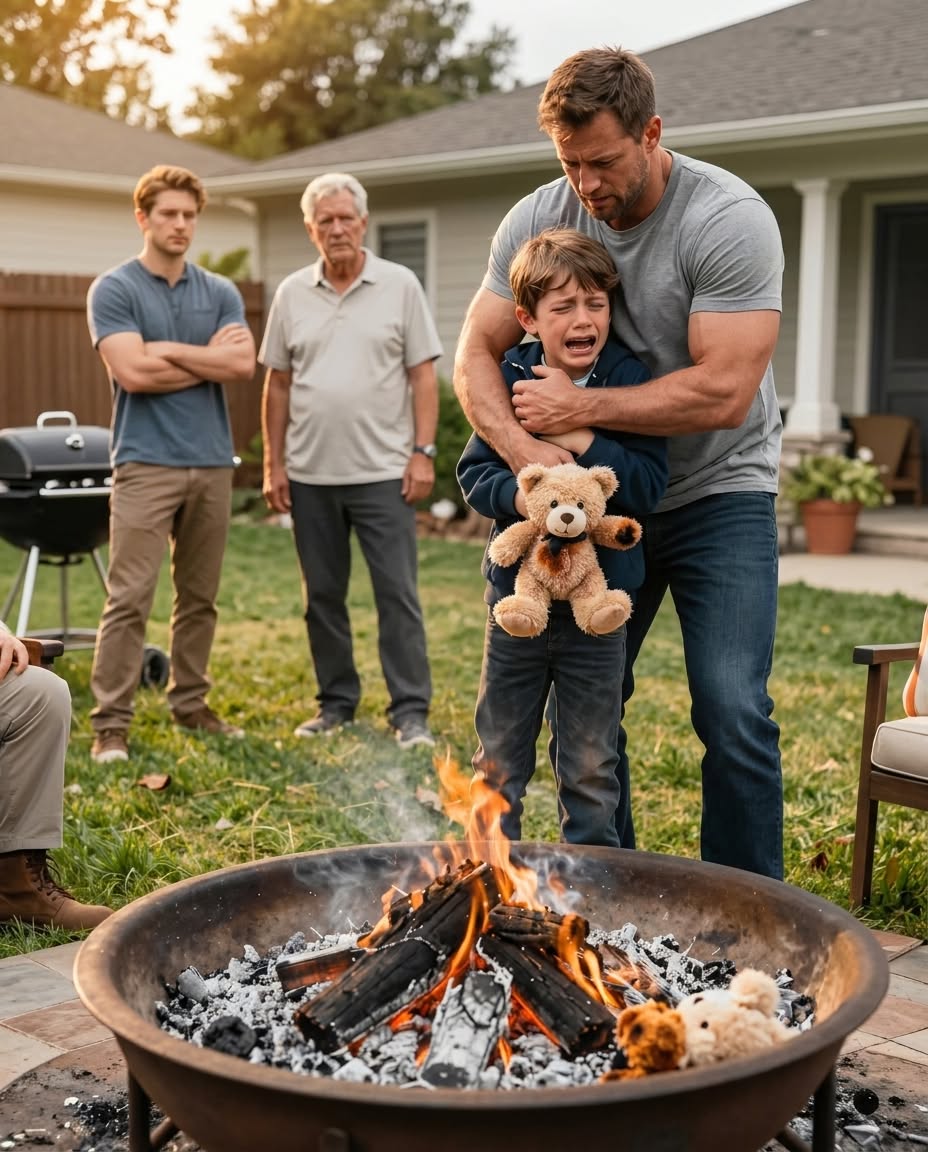
The smell reached me before I understood what was burning. Smoke drifted over my parents’ backyard, mixed with charcoal and barbecue sauce, while my six-year-old son Lucas suddenly stopped beside me and stared toward the fire pit. There, among the blackened wood and glowing coals, were the stuffed animals he had loved for years: a blue elephant, a patchwork turtle, a lion, and Mr. Bamboo, the worn panda he had slept with through thunderstorms, dentist visits and the worst nights after my divorce. Lucas made a small sound and folded into me, sobbing so hard his body shook. Around us, conversations died and plates lowered. Then I saw my brother Derek standing by the cooler with his arms crossed and a satisfied smile. “Honestly, Virgil,” he said, “it’s probably for the best. He needs to toughen up.” My father Frank agreed, calling the toys “crutches,” and in that moment I stopped seeing the fire as a stupid family prank and started seeing it for what it was: grown men deliberately hurting a child because they had confused cruelty with strength.
It was not the first time. My father had mocked Lucas for wanting a kitchen playset, dismissed his drawings without looking at them, and complained that I was not raising him to be masculine enough. Derek had once stood over Lucas after he split his knee open on the driveway and told him to “walk it off like a man” instead of helping him. They had treated my divorce as evidence that something was wrong with the way I parented, and every time Lucas showed softness, creativity or fear, somebody in my family seemed determined to sand it out of him. The barbecue simply brought years of that behavior into one unmistakable moment. When my mother offered to replace the toys, Lucas lifted his tear-streaked face and said, “They were my friends.” My father still answered that they were “just toys.” I carried Lucas out through a hallway decorated with cheerful family photographs and a banner that literally read FAMILY, while my mother begged me not to leave. “Family protects children,” I told her. “It doesn’t break them to prove a point.”
The next evening, my father was sitting on my porch. For one hopeful second, I thought he had come to apologize. Instead, after I sent Lucas inside with the new panda he had chosen that afternoon—not a replacement for Mr. Bamboo, he carefully explained, just “his cousin”—Frank told me Derek was in trouble at work. My brother worked in the sales division at Peterson Tech, the same company where I had spent eleven years building my own professional reputation, and complaints had been filed against him. My father wanted me to intervene. “Family helps family,” he said. I asked one question: “Did family help Lucas yesterday?” He had no answer. The following morning, I learned through HR that Derek’s problem was not a misunderstanding but a documented pattern involving junior employees he publicly humiliated, work he claimed as his own, and a young analyst he had reduced to tears over a presentation error. The behavior from the backyard had followed him into the office. What Derek called toughness at home had become intimidation at work, and suddenly my father was asking me to use my credibility to shield the same behavior he had spent years encouraging.
I refused. I did not contact HR on Derek’s behalf, did not offer professional references, and did not use my position to influence an internal investigation. Six months later, he resigned under pressure after a second complaint escalated into a formal review. My father eventually admitted he had seen the pattern for years but had looked away because confronting Derek meant confronting his own beliefs about masculinity, discipline and emotion. My mother kept trying to “move past it” without ever naming what had happened, even sending Lucas a birthday check that I returned. Derek called once and asked whether I was really cutting him off “over some toys.” I told him that children do not always remember the object that was destroyed; sometimes they remember that the people who should have protected them were the ones holding the match. Less than a year later, I accepted a job six hundred miles away in Vermont. Lucas and I moved into a house with a yard, a better school district and enough distance that nobody could arrive uninvited to teach him another lesson in someone else’s definition of toughness.
Ten years later, Lucas was sixteen and still kept the second panda on a shelf above his desk, its fur worn only because it had been loved. One evening on our Vermont porch, after another phone call from my mother asking whether we were finally coming home, Lucas showed me a small wooden horse he had been carving by hand. He wondered whether his grandfather would have liked it. I told him Frank probably would have considered it too delicate. Lucas ran his thumb across the polished wood and said, “It’s not fragile. It’s just made carefully.” I looked at the young man he had become—kind, confident, unashamed of tenderness—and realized that sentence held everything my family had failed to understand. Care is not weakness. Gentleness is not fear. The toys were gone, the fire pit was long cold, and the people I grew up with had made their choices. I had made mine too. Sitting there listening to my son move through a safe house without ever having learned to fear his own softness, I knew exactly which choice had mattered more.