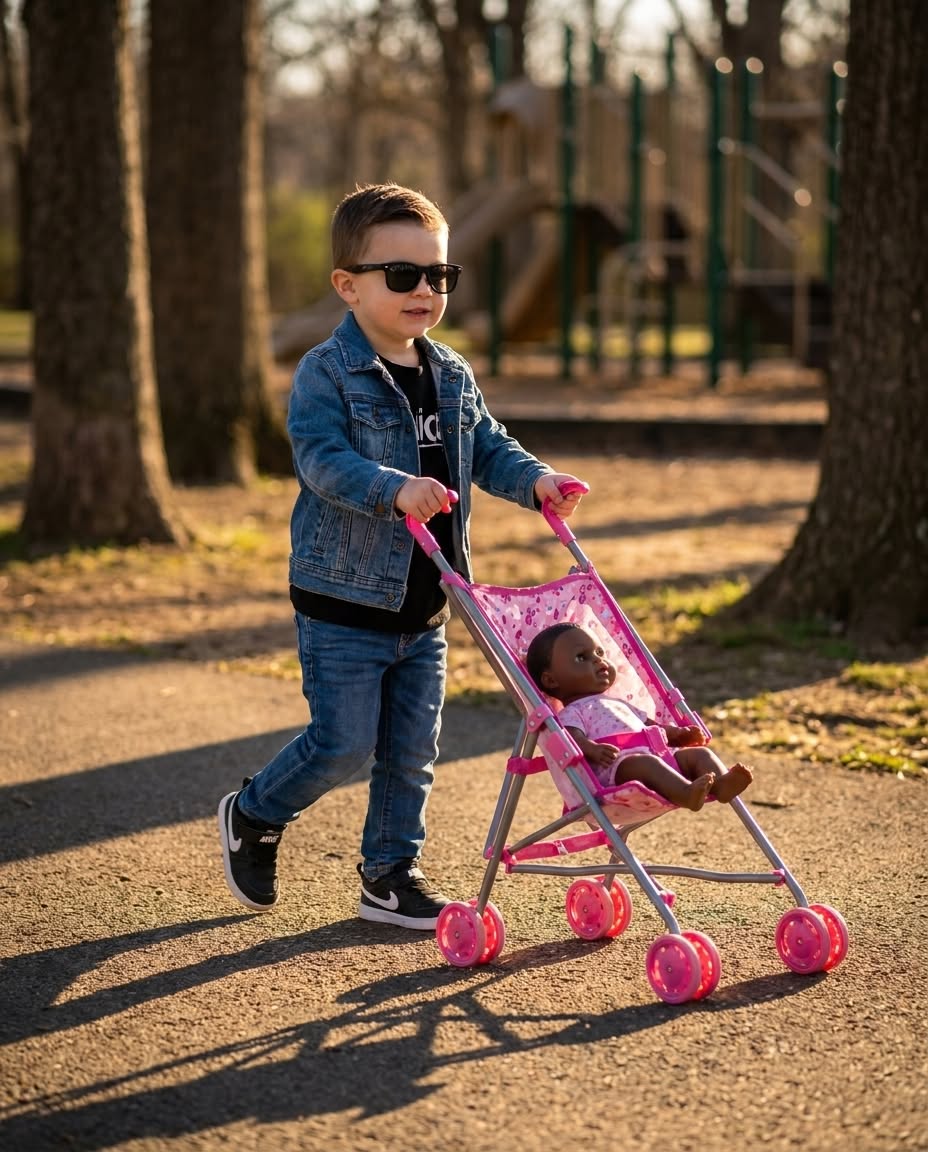
The laughter started the moment Leo pushed his little stroller across the grass. A group of first-grade boys stopped kicking their soccer ball and stared at the two-dollar baby doll tucked beneath an old receiving blanket, then one of them called out, “That’s for girls!” Another asked whether Leo was a “mommy now,” and the others joined in. I was already halfway off the bench, ready to pull my six-year-old out of a moment I assumed would humiliate him. My husband Greg had turned from the swings too, his face tightening with the exact fear he had confessed to me the night before—that Leo’s tenderness would eventually make him a target. But Leo did not cry or drop the stroller. He simply looked at the boys, pointed to the doll and asked, “My dad takes care of me. Is your dad a girl?”
The stroller had come from a neighborhood yard sale the previous weekend. Leo spotted it immediately, along with the plain soft-bodied doll strapped inside, and fell in love with both before Greg and I had time to discuss it. Our son has always attached himself completely to whatever captures his heart: first a blue dump truck, then dinosaurs, then the moon, and now a baby he named, after considerable thought, simply “Baby.” Greg loved Leo fiercely, but he had grown up in a family where boys were taught clear rules about what they were supposed to enjoy and how much tenderness they were allowed to show. He never forbade the doll, yet I could see his discomfort when strangers glanced at our son pushing a pink-trimmed stroller through the grocery store. One evening Greg admitted that he was considering steering Leo toward soccer again, not because he disliked who our son was, but because he feared what other children might do to him. I told him we could not protect Leo from cruelty by teaching him to hide the gentlest parts of himself. Greg understood part of what I meant. The rest was still lodged somewhere deeper.
At the park, Leo answered the boys before either of us could intervene. “Taking care of a baby isn’t for girls,” he explained. “It’s for people who love the baby. My dad takes care of me because he loves me. I take care of Baby because I love him. That’s a dad thing too.” The teasing stopped almost instantly. One boy quietly mentioned that his own father made him breakfast; another said his dad handled bath time. Within minutes, the same children who had been laughing were taking turns pushing the stroller, carefully following Leo’s instructions because Baby was “little.” I stood in the grass trying not to cry, but when I looked toward Greg, I realized something larger had happened. Leo’s entire argument rested on him. To our son, his father was the clearest proof that masculinity and caregiving were never opposites. Greg had spent the previous evening worrying that Leo’s tenderness would make him less acceptable to other boys, only to discover that Leo saw Greg’s own tenderness as evidence of what a man could be.
Greg crouched beside the stroller and helped Leo tuck the blanket around Baby while the other boys watched. On the walk home, he finally told me what had been sitting behind his discomfort. His own father had never cooked breakfast for him, given him a bath or spent much time playing with him. In that household, being a father meant earning money, coming home and sitting in a chair. Greg had always believed he was different because he made Leo’s meals, handled bedtime and pushed him on swings, yet some part of the old definition had survived inside him. He had nearly passed it forward when he considered discouraging the doll simply because other men might judge his son. Leo’s question exposed the contradiction more effectively than any adult argument could have. From then on, Greg stopped treating the stroller like something he needed to tolerate. When its wheel squeaked, he fixed it. When Leo acquired a second doll, Greg sat on the floor holding whichever “baby” he was assigned. And when a stranger at the grocery store later gave him the familiar smirk inviting him to be embarrassed by his son, Greg smiled back and said, “He’s a great little dad, isn’t he?”
I still think about how certain I was that afternoon that my son needed rescuing. Instead, he stood calmly in front of children who were mocking him and corrected the idea behind the insult without becoming cruel himself. Leo was not trying to make a statement about gender or teach anyone a lesson. He was simply defending something he loved and describing the world as he genuinely understood it: people care for smaller people because they love them. The greater lesson belonged to the adults watching. Greg had spent years believing he had escaped the rules of his childhood, only to discover one of them still hiding inside him, and his six-year-old son gave him permission to let it go. A two-dollar stroller did not change our family because Leo played with something unexpected. It changed us because when someone told him caring was something to be ashamed of, he looked at the father who cared for him every day and knew, with absolute certainty, that they were wrong.