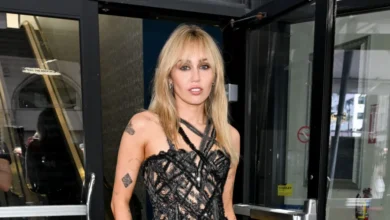
The image appeared without explanation: Miley Cyrus’s face washed in deep red and black, her expression almost swallowed by shadow, and beneath it—nothing. No caption, no statement, no attempt to tell millions of followers what they were supposed to see. Days earlier, she had been photographed entering a Los Angeles recording studio dressed entirely in black, sunglasses shielding much of her face as observers wondered whether grief had left its mark. Now, visitors arriving at her official website encountered another striking detail. Across the page was one stark word: “MILEY.” Not Miley Cyrus. Just Miley. Coming only days after the death of her godmother Dolly Parton, the stripped-down presentation immediately felt to many fans less like ordinary promotion and more like the first quiet signal of a woman standing at the threshold of another transformation.
The timing carried unusual emotional weight because Dolly had never been simply a famous family friend. Miley had known her as “Aunt Dolly,” a godmother whose relationship with the Cyrus family began decades earlier through Billy Ray Cyrus and eventually became woven into Miley’s childhood, career, and public identity. Dolly appeared alongside her on “Hannah Montana,” shared stages with her as the years passed, and remained one of the few people Miley spoke about with a mixture of professional admiration and intimate affection. After Dolly’s death at 80 on August 25, 2026, Miley chose not to reveal the private details of their relationship. Instead, she wrote that their most sacred moments belonged “behind the stage” and “between our hearts,” while sharing one especially telling memory: one of their final conversations had been about “music and metamorphosis.” She said Dolly would have wanted her to grieve, turn the feeling into a song, and then keep moving forward. That word—metamorphosis—would soon take on an entirely different meaning.
Five days later, “MILEY” appeared alone on her website, and the internet began doing what it always does when a celebrity says something by apparently saying nothing at all. Fans wondered whether she had removed “Cyrus” professionally, whether the change was merely visual branding for an upcoming album cycle, or whether something more permanent was unfolding. Some praised her reputation for reinvention, while others connected the apparent rebrand directly to Dolly’s final advice and Miley’s promise to keep creating through grief. The speculation was especially compelling because Miley’s own name has always carried a history of transformation. She was born Destiny Hope Cyrus in 1992, earned the childhood nickname “Smiley Miley” because of her cheerful disposition, and legally became Miley Cyrus as a teenager in 2008. What had once been a nickname became an identity, then a worldwide brand; nearly two decades later, she appeared to be reducing that identity to its simplest possible form. Whether intentional symbolism or not, one thing was undeniable: at a moment when Miley had lost one of the women who helped shape her, the name presented to the public suddenly looked different.
There is, however, an important distinction between what can be seen and what can be concluded. A website displaying “MILEY” does not by itself establish a legal name change, and no public filing or formal statement in the source material confirms that Miley has abandoned “Cyrus.” From a branding standpoint, entertainers often shorten names, redesign visual identities, or introduce campaign-specific typography without altering their legal or contractual identity. The same caution applies to the photographs taken outside the recording studio: fans speculated about swollen eyes and even wondered whether a marking on Miley’s arm depicted Dolly, but those observations remain interpretations rather than confirmed facts. What is confirmed within the story is Miley’s own language about grief, music, strength, and change—and that she placed those thoughts into the world shortly before the minimalist “MILEY” branding appeared. That leaves a narrow but fascinating space between evidence and meaning, and it is precisely inside that space that public curiosity has taken hold.
Perhaps that uncertainty is what makes the moment feel so personal. People who have lived long enough to lose parents, spouses, siblings, mentors, and lifelong friends understand that grief does not always announce itself through grand gestures. Sometimes it arrives as a changed routine, a room rearranged, an old photograph brought closer, or a name suddenly written differently. Miley may eventually explain that the one-word presentation was simply part of a new creative campaign, or she may reveal that it represents something deeper. For now, the answer remains hers. Yet after a lifetime that began as Destiny Hope, grew into Miley Cyrus, and was shaped in part by a godmother who encouraged her to keep evolving, the sight of that single name carries a certain emotional resonance. Whatever comes next, she seems to be stepping toward it with less decoration than before—one word, one identity, and the memory of Dolly still very much beside her.