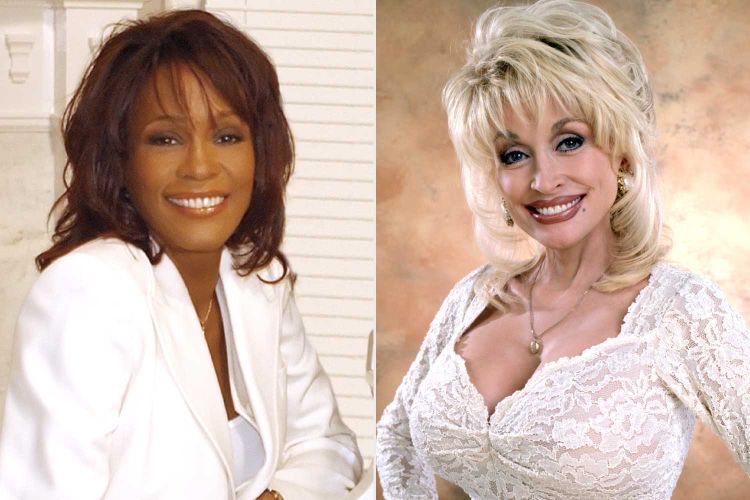
Few songs are as instantly recognizable as “I Will Always Love You.”
For millions of listeners, the opening notes immediately bring Whitney Houston’s extraordinary voice to mind. Her recording became a worldwide phenomenon and remains one of the defining performances of her career.
But behind Whitney’s legendary version was another music icon: Dolly Parton, who wrote and originally recorded the song years earlier.
Whitney never overlooked that fact.

She openly praised Dolly’s talent as both a songwriter and singer, showing the respect that existed between two women whose careers became forever connected through one remarkable song.
A Song That Connected Two Legends
Dolly originally wrote “I Will Always Love You” in the 1970s.
Years later, Whitney recorded her own version for The Bodyguard, the 1992 film in which she starred alongside Kevin Costner.
Whitney transformed the song into a soaring vocal showcase.
Her performance introduced Dolly’s songwriting to an enormous new audience and helped turn an already beloved country song into an international pop phenomenon.
Yet the success wasn’t simply about one artist replacing another.
Instead, it became a rare example of two completely different interpretations of the same composition becoming iconic in their own right.
Whitney’s Respect for Dolly
Whitney understood exactly where the song came from.
She credited Dolly’s abilities as a writer and singer while discussing the enormous success surrounding her version.
That respect makes their connection particularly meaningful today.
Dolly created the words and melody. Whitney brought her unmistakable vocal power and interpretation.
Together, without actually performing the famous recording as a duet, the two women created a piece of music history that continues to reach new generations.
Two Voices That Cannot Be Replaced
Both artists developed identities that went far beyond a single recording.
Whitney became celebrated as one of the most powerful vocalists of her generation, while Dolly built a decades-long career encompassing songwriting, performing, acting and philanthropy.
Their styles were different, but their influence was enormous.
And “I Will Always Love You” created a permanent connection between their musical stories.
Decades later, listeners still debate which version they prefer. Others refuse to choose at all, appreciating Dolly’s intimate original and Whitney’s breathtaking interpretation for completely different reasons.
Perhaps that is the greatest testament to the song itself.
A truly exceptional composition can survive different eras, genres and voices while still touching people every time it is heard.