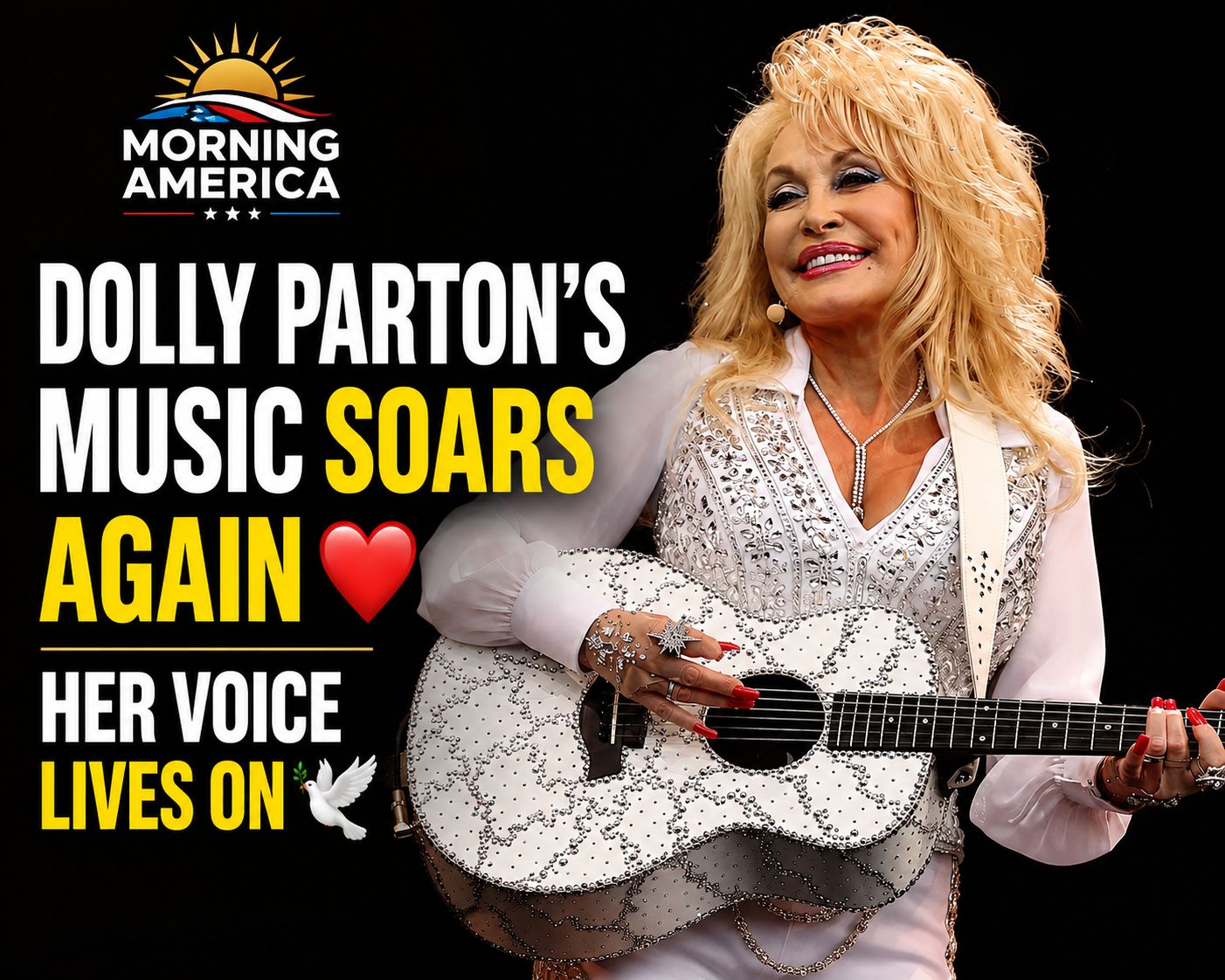
Dolly Parton’s Music Soars Again as Fans Return to the Songs That Defined Generations

Few artists leave behind a collection of songs capable of connecting grandparents, parents and younger listeners at the same time.
Dolly Parton was one of them.
Following her death at age 80, fans around the world have returned to the music that made her one of the most recognizable voices in American entertainment.
Songs that were released decades ago are being heard again, shared again and introduced to a new generation of listeners.
But for many longtime fans, listening to Dolly Parton isn’t simply about music.
It’s about memories.
The Songs That Became Part of People’s Lives
For nearly six decades, Dolly built an extraordinary catalog of music.
There was “Jolene,” the instantly recognizable song about a woman pleading with another woman not to take the man she loves.
There was “9 to 5,” an energetic anthem that became closely associated with working life and the hugely successful movie of the same name.
And then there was “I Will Always Love You.”
Dolly wrote the song herself and originally released it in 1974.
Years later, Whitney Houston’s powerful version introduced the composition to an enormous new international audience through The Bodyguard.
Different generations may associate the song with different voices, but at its heart remained Dolly’s songwriting.
That ability to create music that could survive changing trends was one of the defining characteristics of her career.
Fans Are Returning to the Classics
When a beloved artist dies, people often return to the music that first made them fall in love with that performer.
A familiar song can suddenly carry a different emotional weight.
For someone who remembers hearing Dolly on the radio as a child, playing one of her songs today may bring back memories of parents or grandparents.
Another listener may remember watching 9 to 5.
Someone younger may discover “Jolene” through a playlist or social media and realize that a song written more than half a century ago still feels remarkably immediate.
That’s the unusual power of music.
The artist may belong to a particular generation, but a great song doesn’t necessarily stay there.
More Than a Famous Voice
Dolly’s career was remarkable not only because she could sing, but because she was an accomplished songwriter.
Behind the glamorous outfits, unmistakable blonde hair and larger-than-life public personality was a musician who understood storytelling.
Her songs could be funny, heartbreaking, hopeful or deeply personal.
They often told stories using simple language that listeners could immediately understand.
That accessibility helped her music travel far beyond traditional country audiences.
Even people who rarely listened to country music knew Dolly Parton.
Her personality also played an enormous role in that connection.
She became known for being able to laugh at herself while simultaneously demonstrating sharp business instincts and a clear understanding of her own public image.
A Career That Crossed Generations
Longevity in the music industry is difficult.
Styles change.
Audiences change.
New stars arrive every year.
Yet Dolly remained culturally relevant for decades.
She moved between music, movies, television, business and philanthropy while maintaining the identity that audiences had come to recognize.
Most importantly, she continued to be associated with the songs she had written many years earlier.
That’s an achievement that can’t simply be measured through awards or chart positions.
It means the music became part of popular culture itself.
“I Will Always Love You” Carries New Meaning
Of all Dolly’s songs, the title “I Will Always Love You” feels particularly meaningful during a period when fans are remembering her life.
Originally, the song wasn’t written as a traditional romantic breakup song. Dolly wrote it while moving on professionally from her longtime musical partnership with Porter Wagoner.
The lyrics expressed gratitude while acknowledging that sometimes people must continue on separate paths.
Over time, listeners found their own meanings in the song.
That’s what happens with music that lasts.
Eventually, it belongs partly to the audience.
People attach their own relationships, losses, celebrations and memories to it.
Her Voice Lives On
There is an inevitable sadness when the world loses an entertainer whose career lasted for generations.
But recorded music creates something extraordinary.
A performance doesn’t disappear when the performer is gone.
Someone can press play tomorrow, ten years from now or decades into the future and hear that voice again.
A child who wasn’t alive during Dolly’s greatest commercial years can discover “Jolene.”
Someone can watch 9 to 5 for the first time.
Another singer can perform “I Will Always Love You” and introduce Dolly’s songwriting to yet another audience.
That cycle can continue indefinitely.
A Legacy Measured in Memories
Charts and awards document a career.
Memories tell a different story.
For millions of people, Dolly’s legacy will be measured in moments: hearing one of her songs in the family car, watching her on television, dancing to “9 to 5,” or remembering someone they loved whenever “I Will Always Love You” begins playing.
That is why her music continues to matter.
The performances may belong to history, but the songs remain alive every time someone presses play.
And as millions of listeners return to the music that defined generations, one message feels especially appropriate:
Her voice lives on. ❤️🕊️